Introduction
Silicone potting compounds play an important role in protecting electronic assemblies from moisture, dust, vibration, temperature variations and other environmental conditions. They are widely used in LED drivers, power supplies, outdoor lighting systems, sensors, automotive electronics and industrial control equipment.
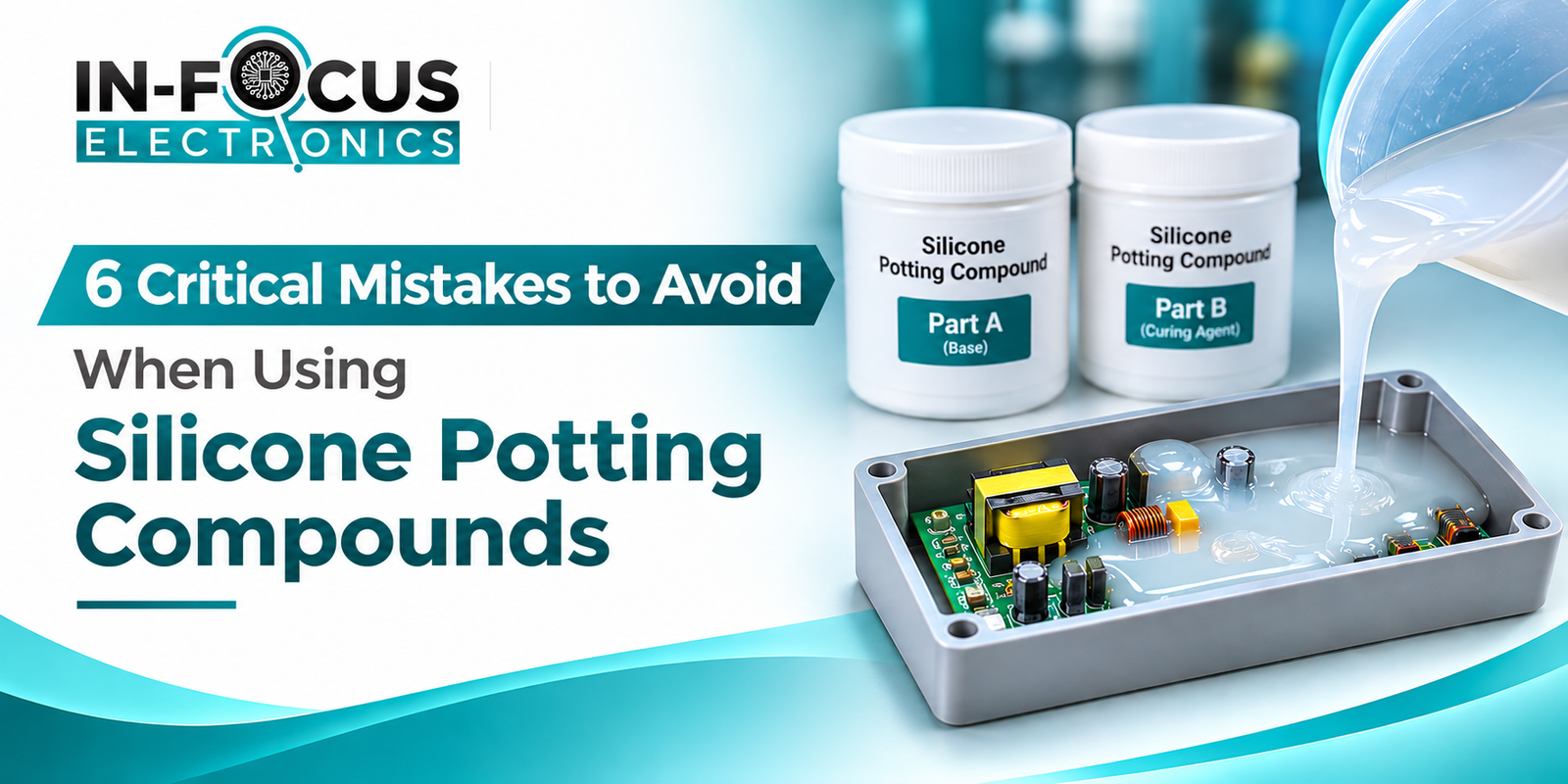
Two-part silicone potting compounds generally consist of Part A (base compound) and Part B (curing agent). When mixed in the correct proportion, these materials undergo a chemical curing process and form a flexible protective layer around sensitive electronic components.
However, even high-quality silicone potting compounds can fail to deliver the expected protection if they are not handled and applied correctly. Incorrect mixing ratios, incomplete mixing, surface contamination and improper curing are some of the common mistakes that can affect the performance and reliability of potted electronic assemblies.
In this guide, we discuss six critical mistakes to avoid when using silicone potting compounds and explain practical ways to achieve better encapsulation results.
1. Using an Incorrect Mixing Ratio (Part A and Part B)
The Mistake: Measuring Part A and Part B incorrectly or estimating the mixing ratio without following the manufacturer's technical datasheet. Some users also measure by volume when the specified ratio is based on weight.
Different silicone formulations have different mixing requirements. The density of Part A and Part B may also vary, making volume-based measurement unsuitable when a weight-based ratio is specified.
The Consequences:
- Incomplete or uneven curing.
- Sticky or soft areas on the cured surface.
- Reduced mechanical and protective performance.
- Uncured material remaining inside the electronic housing.
How to Avoid It:
- Always check the recommended mixing ratio in the manufacturer's technical datasheet.
- Use a calibrated digital weighing scale when the ratio is specified by weight.
- Never estimate or randomly adjust the quantity of Part A and Part B.
- Measure each component accurately before mixing.
For example, a silicone compound may have a 1:1 or 10:1 mixing ratio by weight. Always follow the specific product formulation rather than assuming that all silicone compounds use the same ratio.
2. Incomplete or Overly Aggressive Mixing
The Mistake: Mixing only the centre of the container without scraping its sides and bottom, or stirring too aggressively and introducing excessive air into the compound.
Both components must be distributed uniformly to ensure consistent curing throughout the mixture. Inadequate mixing can leave portions of unmixed material, while excessive stirring can introduce air bubbles.
The Consequences:
- Uncured pockets inside the potted assembly.
- Uneven curing and inconsistent material properties.
- Air bubbles trapped inside the compound.
- Reduced insulation and protective performance.
How to Avoid It:
- Use a clean and dry mixing container.
- Mix slowly and thoroughly using an appropriate mixing tool.
- Scrape the sides and bottom of the container repeatedly.
- Continue mixing until the compound has a uniform appearance and consistency.
- Follow the manufacturer's recommended mixing time.
Avoid excessive stirring speeds because they can introduce unnecessary air into the silicone mixture.
3. Ignoring Chemical Inhibition (Cure Poisoning)
The Mistake: Applying addition-cure (platinum-catalysed) silicone potting compounds over surfaces or electronic components contaminated with chemicals that interfere with the curing reaction.
Certain materials and chemical residues can inhibit the curing process of platinum-catalysed silicone compounds.
Common Sources of Cure Inhibition:
- Sulphur-containing rubber gaskets and O-rings.
- Amine-cured epoxy materials.
- Certain PVC materials and adhesive tapes.
- Some soldering flux residues.
- Organotin-containing compounds and other incompatible chemicals.
The Consequences:
- Sticky or uncured silicone around contaminated surfaces.
- Poor bonding between the silicone and electronic components.
- Weak protective encapsulation.
- Potential moisture entry and electrical reliability problems.
How to Avoid It:
- Check the compatibility of all materials that will contact the silicone.
- Remove flux residues and other contaminants using a PCB-compatible cleaning process.
- Use isopropyl alcohol (IPA) only where it is compatible with the PCB, components and surface materials.
- Allow cleaned surfaces to dry completely.
- Perform a small compatibility and curing test before starting full-scale production.
Always verify material compatibility, particularly when working with addition-cure silicone compounds.
4. Trapping Air Bubbles During Pouring
The Mistake: Pouring the mixed silicone compound too quickly or directly over complex electronic assemblies without allowing the material to flow around the components.
Air can become trapped beneath transformers, integrated circuits, connectors, heatsinks and other closely spaced electronic components.
The Consequences:
- Voids and air pockets inside the encapsulated assembly.
- Reduced contact between the silicone and component surfaces.
- Potential moisture pathways.
- Reduced thermal transfer where thermal management is important.
- Possible mechanical stress during temperature variations.
How to Avoid It:
- Pour the silicone slowly from a suitable single point.
- Allow the compound to flow naturally around the components.
- Avoid pouring from multiple directions unnecessarily.
- Use vacuum degassing where the material formulation and process permit it.
Vacuum degassing can help remove entrapped air from mixed silicone compounds. Follow the manufacturer's recommendations for vacuum level and duration, and ensure the compound does not overflow during the process.
5. Pouring on Uncleaned or Moisture-Laden PCBs
The Mistake: Applying silicone potting compound over electronic assemblies containing dust, soldering flux residue, oil, moisture or other surface contaminants.
Surface contamination can affect adhesion and may interfere with the curing process. Moisture trapped beneath the encapsulation layer can also contribute to long-term reliability problems.
The Consequences:
- Poor adhesion between silicone and PCB surfaces.
- Delamination or gaps around electronic components.
- Potential moisture-related electrical failures.
- Reduced long-term protection of the electronic assembly.
How to Avoid It:
- Clean PCBs and housings before applying the compound.
- Remove dust, oil, flux residue and other contaminants.
- Ensure all surfaces are completely dry before potting.
- Use an approved cleaning process suitable for the electronic components.
- Where moisture removal requires pre-baking, follow the PCB and component manufacturers' temperature and time limits.
Proper surface preparation is essential for achieving reliable encapsulation and long-term protection.
6. Rushing the Silicone Curing Process
The Mistake: Handling, moving or testing an electronic assembly before the silicone compound has reached the required curing stage.
Two-part silicone potting compounds require sufficient time to complete their chemical curing reaction. The curing time depends on the formulation, ambient temperature, material thickness and other processing conditions.
The Consequences:
- Deformation of the uncured compound.
- Movement or displacement of electronic components.
- Incomplete mechanical protection.
- Reduced reliability of the encapsulated assembly.
How to Avoid It:
- Check the specified pot life and working time before mixing.
- Allow sufficient curing time before handling the assembly.
- Follow the recommended temperature and curing conditions.
- Do not assume that surface dryness means the compound is fully cured.
- Confirm that the silicone has reached the required cure stage before final testing and assembly.
Many two-part silicone compounds require approximately 24 hours or longer to cure under specified room-temperature conditions. However, actual curing times vary by product, so always consult the technical datasheet.
Technical Selection Guide: Choosing the Right Protection
Selecting the correct protective material is just as important as applying it properly. Different lighting and electronic applications require different levels of protection.
| Application | Recommended Solution |
|---|---|
| Outdoor LED street lights and flood lights | Suitable silicone potting compounds for moisture and environmental protection. |
| LED drivers and power supplies | Thermally conductive potting compounds where heat transfer is required. |
| Transparent electronic encapsulation | Optically clear silicone compounds. |
| Waterproof cable entry points | Suitable IP-rated cable glands and connectors. |
Explore our Silicone Potting Compounds and Encapsulation Materials for electronic protection applications.
For cable entry and sealing requirements, explore our range of Cable Glands and Electrical Accessories.
Why Proper Silicone Potting Matters for LED Manufacturers
LED drivers, outdoor lighting equipment and electronic power supplies are frequently exposed to demanding operating conditions. Proper encapsulation helps protect sensitive electronic components against moisture, dust, vibration and environmental exposure.
However, the performance of a potted assembly depends on several factors, including compound selection, mixing accuracy, surface preparation, application technique and curing conditions.
Following the correct manufacturing procedure helps improve product consistency, reduce processing defects and support the long-term reliability of electronic equipment.
Conclusion
Silicone potting compounds provide an effective solution for protecting electronic assemblies when the correct material and application process are used. However, mistakes such as incorrect mixing ratios, incomplete mixing, chemical contamination, trapped air bubbles, uncleaned PCBs and rushed curing can compromise the final result.
By following the manufacturer's technical guidelines and maintaining proper manufacturing practices, LED manufacturers and electronics assemblers can achieve more consistent encapsulation and improve the reliability of their products.
Contact INFOCUS ELECTRONICS
Looking for reliable silicone potting compounds and encapsulation materials for your LED lighting or electronic applications? Get in touch with INFOCUS ELECTRONICS for your requirements.
We cater to LED manufacturers, OEMs, electronics assemblers, electrical contractors, traders and wholesalers across India.
Contact Number: +91 93219 32158
Website: www.infocuselectronics.com
Bulk & Retail Enquiries Welcome!