Why 2x2 LED Lenses Are the Secret Weapon of High-Bay Lighting Efficiency
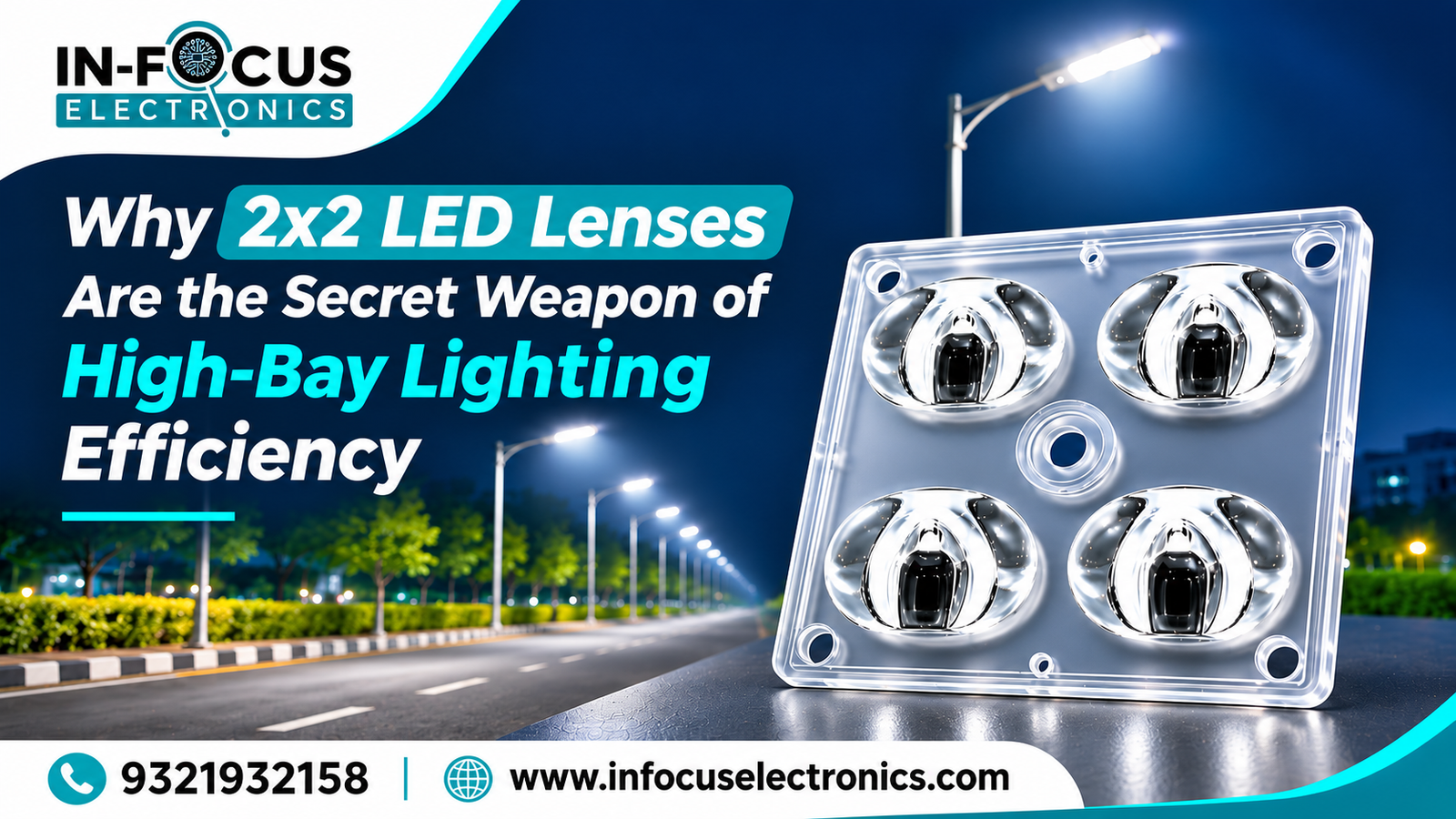
When designing high-bay LED lights for warehouses, factories, manufacturing plants and industrial spaces, most manufacturers focus on LED chips, wattage and lumen output. However, one important component that often determines actual lighting performance is secondary optics – particularly 2x2 LED lenses.
A high-quality 2x2 LED lens helps control beam distribution, improve light utilization and direct illumination towards the required working area. Instead of allowing light to spread unnecessarily, it helps create a more controlled and application-specific lighting pattern.
Let's understand why 2x2 LED lenses are becoming an important choice for modern high-bay lighting applications.
1. Primary Optics vs. Secondary Optics: Understanding the Difference
LED lighting systems use different optical components to manage light distribution.
Primary Optics: These are generally integrated into the LED package. They protect the LED chip and influence its initial light distribution.
Secondary Optics: These are external optical components installed over or around the LEDs. They help shape, focus and redirect light according to the lighting application's requirements.
In industrial lighting, secondary optics are particularly important because high ceilings require controlled light distribution to illuminate floors, machinery, production lines and workstations effectively.
2. How Optical Technology Improves High-Bay Lighting
High-bay lighting installations are commonly used at mounting heights of approximately 8 to 15 metres or more.
At these heights, uncontrolled light distribution can result in wasted illumination, uneven brightness and unnecessary light spill.
Depending on their optical design, 2x2 LED lenses can use Total Internal Reflection (TIR), refraction or a combination of optical principles to control the direction of light.
A properly designed lens helps:
- Direct light towards the required working surface.
- Reduce unnecessary light spill.
- Improve illumination uniformity.
- Achieve suitable beam angles for different mounting heights.
Optical transmittance, beam distribution and lens geometry all influence the final performance of the lighting fixture.
3. Why 2x2 Modular LED Lenses Are Popular in Industrial Lighting
A. Compact and Modular Design
The 2x2 configuration provides a compact optical arrangement with four individual optical positions. This makes it suitable for lighting modules requiring a structured LED and lens layout.
B. Flexible LED Compatibility
Depending on the specific lens model, 2x2 optics can support different SMD LED packages, including 3030, 3535, 5050 and 7070.
This gives lighting manufacturers flexibility when designing different wattages and fixture configurations.
C. Controlled Beam Distribution
Different beam angles are suitable for different lighting requirements:
- 30° Beam Angle: Suitable for more concentrated illumination.
- 60° Beam Angle: Useful for focused industrial lighting.
- 90° Beam Angle: Suitable for wider light distribution.
The correct selection depends on mounting height, fixture spacing and the required illumination level.
D. Flexible Fixture Design
Modular optics make it easier for manufacturers to develop different fixture configurations without redesigning the complete optical system for every application.
4. Why Material Quality Matters: Optical Polycarbonate vs. Low-Grade Plastics
The material used in an LED lens directly affects its long-term optical performance.
Low-quality plastic optics may experience yellowing, reduced transparency, deformation or deterioration when exposed to prolonged heat, UV radiation and environmental conditions.
High-quality optical-grade polycarbonate offers several advantages:
- Good optical transparency.
- High impact resistance.
- Better dimensional stability.
- Suitable thermal performance when properly specified.
- Availability of UV-stabilized grades.
For industrial high-bay lighting, choosing the correct optical material is essential for maintaining consistent light distribution and product durability.
5. How to Choose the Right 2x2 LED Lens
Before selecting a 2x2 LED lens for an industrial lighting fixture, manufacturers should consider several important technical factors.
- Beam Angle: Choose between 30°, 60°, 90° or other available distributions according to the lighting requirement.
- LED Compatibility: Check compatibility with 3030, 3535, 5050 or 7070 SMD LED packages.
- Module Size: Ensure the lens dimensions match the PCB and fixture design.
- Optical Material: Prefer suitable optical-grade polycarbonate (PC) or PMMA.
- Optical Transmittance: Check the manufacturer's specified transmittance to understand how effectively the lens transmits light.
- Mounting Height: Select the appropriate optical distribution according to the installation height.
- Light Distribution: Consider illumination uniformity, fixture spacing and the required working area.
Selecting a lens based only on its beam angle is not sufficient. A complete optical evaluation should consider the LED source, fixture design, mounting height and application requirements.
6. Applications of 2x2 LED Lenses
2x2 LED lenses are suitable for various lighting applications, depending on their optical configuration.
Common applications include:
- Industrial high-bay LED lights.
- Warehouse lighting.
- Factory and manufacturing facility lighting.
- Commercial industrial lighting.
- LED floodlight fixtures.
- Large indoor lighting installations.
These optical modules help manufacturers develop lighting fixtures designed for specific illumination requirements.
Conclusion: Better Optics, Better Lighting Performance
LED efficiency is not determined by the LED chip alone. The optical system plays an equally important role in deciding how effectively generated light reaches the intended surface.
A properly selected 2x2 LED lens can help manufacturers achieve controlled beam distribution, better illumination uniformity and application-specific lighting performance.
For lighting manufacturers and OEMs, investing in quality secondary optics is an important step towards developing reliable and efficient LED lighting solutions.
Looking for Quality 2x2 LED Lenses?
Explore optical solutions and lighting components available at IN-FOCUS ELECTRONICS.
Contact IN-FOCUS ELECTRONICS
Website: www.infocuselectronics.com
Phone: +91 93219 32158
Your trusted source for LED optical lenses and lighting components.