How LED Lenses Control Light Direction and Beam Angles
LED lighting is used in street lights, flood lights, high bay lights, industrial fixtures, and commercial lighting systems. However, producing light is only one part of an effective lighting solution. Directing that light toward the required area is equally important.
This is where LED optical lenses play an essential role.
An LED lens is an optical component designed to collect and redirect light from an LED source into a particular beam pattern. Depending on its optical design, it can concentrate light, spread it over a wider area, or create a specialised distribution for a particular application.
For LED lighting manufacturers, OEMs, and lighting designers, understanding how lenses control light direction helps in selecting suitable optics for different lighting requirements.
What Is an LED Optical Lens?
An LED optical lens is a specially designed component that changes the direction and distribution of light emitted by an LED.
Without suitable secondary optics, an LED may distribute light over a pattern that does not match the requirements of the application. An optical lens helps shape this output into a more useful distribution.
LED lenses are available in different shapes, sizes, beam angles, and optical configurations. Some are designed for individual LEDs, while others are manufactured as multi-LED arrays for lighting fixtures containing several LED packages.
The correct lens depends on the LED package, optical design, fixture construction, and intended lighting application.
How Does an LED Lens Change the Direction of Light?
LED lenses work by refracting light as it passes between materials with different refractive indices. Their curved surfaces, internal geometry, and optical features influence the direction in which light travels.
Depending on the design, a lens can:
- Concentrate light into a relatively narrow beam.
- Spread light across a wider area.
- Shape light into an elongated or asymmetric distribution.
- Help improve illumination uniformity across a target area.
- Reduce unwanted light spill when used in a suitable optical system.
The result depends on the lens geometry, LED characteristics, alignment, and the complete luminaire design.
A lens does not generate additional light. Instead, it helps direct the available LED output toward the intended application.
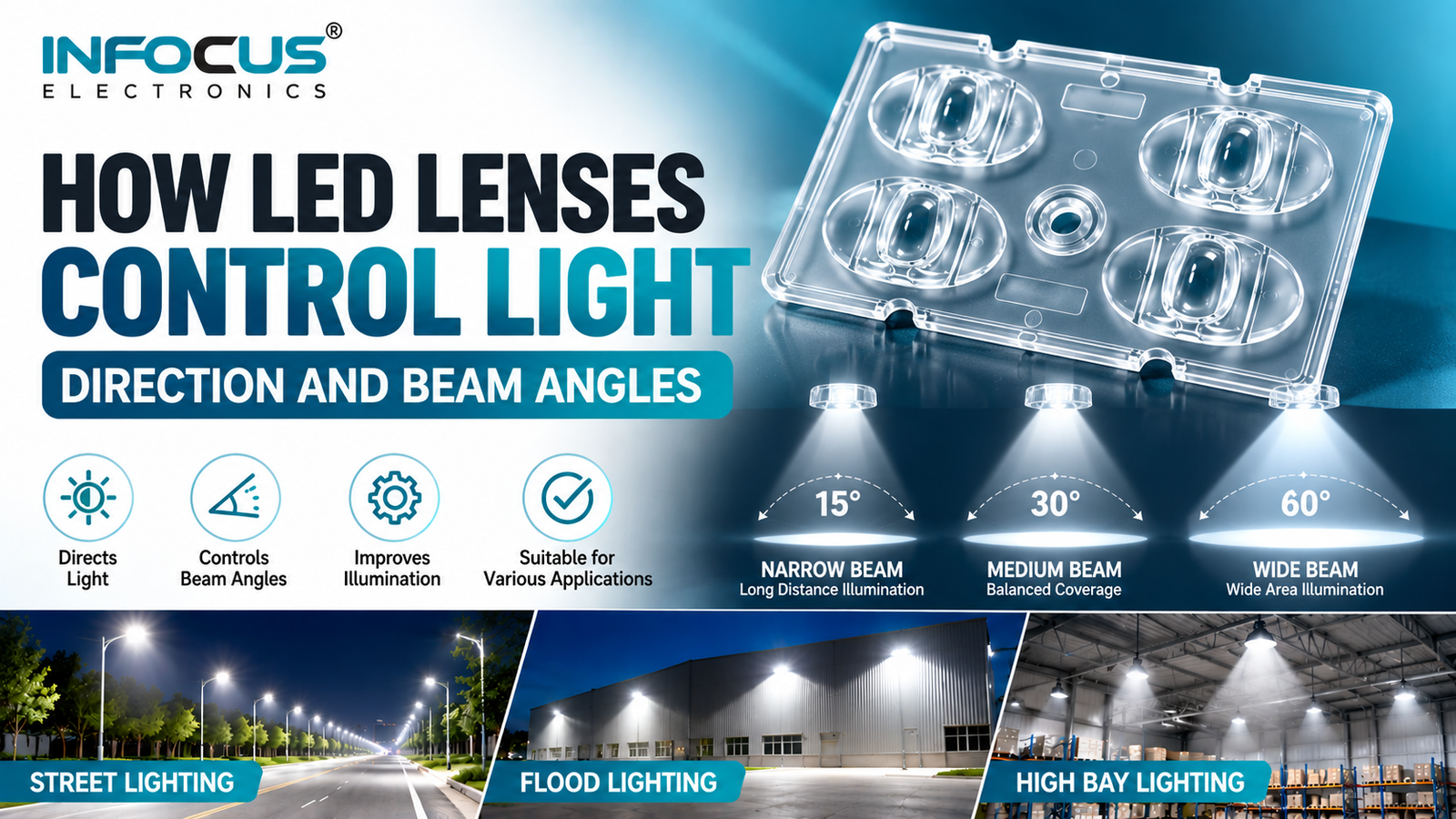
Understanding Narrow, Medium, and Wide Beam Angles
Beam angle is an important consideration when selecting an LED lens. It describes the angular spread of the main light beam, commonly measured between the directions where intensity falls to 50% of its peak value.
1. Narrow Beam LED Lenses
Narrow-beam optics concentrate light into a smaller angular region.
They may be suitable when light needs to reach a distant target or when concentrated illumination is required.
Typical applications include:
- High-mast lighting.
- Long-distance outdoor illumination.
- Focused floodlighting.
- Selected high-bay lighting designs.
A narrow beam does not automatically guarantee better performance. The mounting height, target distance, LED output, and required coverage must also be considered.
2. Medium Beam LED Lenses
Medium-beam optics balance light concentration and coverage.
They can be useful when a fixture needs to illuminate a practical area without concentrating all the light into a very small region or spreading it excessively.
Typical applications include:
- Industrial lighting.
- Warehouses.
- Commercial spaces.
- General floodlighting.
- Selected outdoor area lighting.
The appropriate beam angle depends on the dimensions and layout of the illuminated area.
3. Wide Beam LED Lenses
Wide-beam optics distribute light across a larger angular region.
They can be useful when broad coverage is required, particularly for areas relatively close to the lighting fixture.
Typical applications include:
- Open industrial areas.
- Parking areas.
- Warehouses.
- General area lighting.
- Broad floodlighting applications.
A wide beam may provide insufficient illumination at longer distances if the available light is spread too widely. Optical selection should therefore consider both coverage and required illuminance.
How LED Lenses Are Used in Different Lighting Applications
LED Street Light Lenses
Street lighting requires controlled distribution across the roadway rather than simply producing a circular pool of light directly beneath a pole.
Street light lenses can be designed to distribute light along and across a road, helping lighting manufacturers address roadway geometry, pole spacing, mounting height, and illumination uniformity.
The appropriate optical distribution depends on road width, installation position, pole height, LED arrangement, and project requirements.
LED Flood Light Lenses
Floodlights are used to illuminate open spaces, building exteriors, industrial yards, parking areas, and other outdoor locations.
The lens helps control how light spreads across the target area.
A narrower distribution may be useful for longer throw distances, while a wider distribution may be appropriate for broader coverage at shorter distances. The final selection should also account for glare, light spill, fixture aiming, and overlap between neighbouring fixtures.
LED High Bay Lenses
High bay lights are commonly installed in warehouses, factories, and other spaces with high ceilings.
Their optical design helps direct light toward floors, workstations, aisles, and storage areas.
The correct lens depends on ceiling height, fixture spacing, aisle arrangement, required illumination, and LED output. A suitable distribution can help reduce dark areas and improve lighting uniformity.
Why LED Package Compatibility Matters
An optical lens must be compatible with the LED package and PCB arrangement for which it is intended.
Common LED package formats include 3030, 3535, and 5050, among others.
When selecting a lens, check:
- LED package and emitting surface.
- Lens dimensions and optical centre.
- LED-to-lens alignment.
- PCB layout and LED spacing.
- Lens mounting and mechanical fit.
- Required beam distribution.
A lens that physically fits a fixture may not necessarily produce the intended optical performance. Always confirm compatibility with the specific LED and lens design.
Important Factors When Selecting an LED Lens
Before choosing an LED optical lens, consider the following factors.
1. Beam angle: Determine whether concentrated, balanced, broad, or asymmetric light distribution is required.
2. Mounting height: Consider the distance between the light source and the target area.
3. Coverage area: Identify the dimensions and shape of the area that needs illumination.
4. LED compatibility: Confirm the lens is designed for the intended LED package and arrangement.
5. Optical performance: Review available photometric data, beam distribution, optical efficiency, and uniformity.
6. Material and environment: Select a suitable optical material and verify temperature, UV exposure, and environmental requirements for the application.
7. Fixture design: Check mechanical dimensions, alignment, mounting arrangements, and compatibility with the luminaire housing.
For demanding projects, photometric simulations and appropriate lighting measurements can help verify the final result.
Common Mistakes to Avoid
Choosing an LED lens based only on its beam angle or physical appearance can lead to disappointing lighting results.
Avoid these common mistakes:
- Selecting a lens without checking LED package compatibility.
- Choosing a beam angle without considering mounting height.
- Ignoring the required illuminated area.
- Assuming that a wider beam always provides better illumination.
- Assuming that a narrower beam always produces a better lighting result.
- Overlooking alignment, glare, and unwanted light spill.
- Selecting optics without reviewing the requirements of the complete fixture.
A properly selected lens should match the actual lighting objective rather than relying on a single specification.
Frequently Asked Questions
What does an LED lens do?
An LED lens redirects and shapes the light emitted by an LED to create a desired beam distribution.
Can an LED lens change the beam angle?
Yes. Different optical lens designs can produce different beam angles and light distribution patterns. The actual result depends on the LED and the optical system.
Which LED lens is suitable for street lights?
The suitable lens depends on roadway width, pole height, pole spacing, LED arrangement, and required light distribution. Roadway-specific optics may be preferable to a simple symmetric beam.
Which lens is suitable for flood lights?
The correct floodlight lens depends on the target area, mounting distance, required coverage, LED configuration, and desired beam distribution.
Are LED lenses available for 3030, 3535, and 5050 LEDs?
Yes, lens designs are available for various LED package formats. However, compatibility must be verified against the particular LED model, optical position, and mechanical layout.
Does an LED lens increase brightness?
An LED lens does not create additional light. By redirecting the available output, it can increase light intensity in a particular direction, but the overall result depends on optical efficiency and the complete lighting system.
Looking for LED Optical Lenses for Your Lighting Applications?
INFOCUS ELECTRONICS supplies LED optical lenses and lighting components for lighting manufacturers, OEMs, traders, and other businesses.
Whether you are developing street lights, flood lights, high bay lights, or other LED lighting products, selecting compatible optics is an important part of achieving the required light distribution.
Contact INFOCUS ELECTRONICS to discuss your LED lens requirements, available models, LED compatibility, and bulk purchasing enquiries.
Explore our website: https://www.infocuselectronics.com/
Conclusion
LED optical lenses play an important role in directing light where it is needed. By shaping beam angles and distribution patterns, they help lighting manufacturers develop fixtures for different installation heights, coverage areas, and lighting applications.
Selecting the right lens requires consideration of the LED package, optical design, mounting conditions, fixture geometry, and desired illumination.
For LED lighting manufacturers and OEMs, understanding these factors is an important step toward selecting suitable optical components for reliable lighting solutions.