Introduction
Outdoor electrical installations require reliable protection against dust, rain, water spray and moisture. Whether you manufacture LED street lights, floodlights, electrical junction boxes or industrial control panels, selecting the right cable gland is essential for protecting cable entry points.
But what do IP65, IP66, IP67 and IP68 mean? Which rating is suitable for outdoor lighting? In this guide, INFOCUS ELECTRONICS explains the IEC IP code, the differences between common protection ratings and how to choose suitable cable glands for your application.
What Is the IEC IP Code?
The IP code stands for Ingress Protection. IEC 60529 is the international standard that classifies protection provided by enclosures against access to hazardous parts, solid foreign objects and water.
An IP rating generally contains two digits. The first digit indicates protection against solid objects and dust, while the second digit indicates protection against water.
- First digit: Protection against access to hazardous parts and solid foreign objects, including dust.
- Second digit: Protection against water under specified test conditions.
For example, IP67 indicates dust-tight protection and protection against temporary immersion in water under specified test conditions.
What Does IP65 Mean?
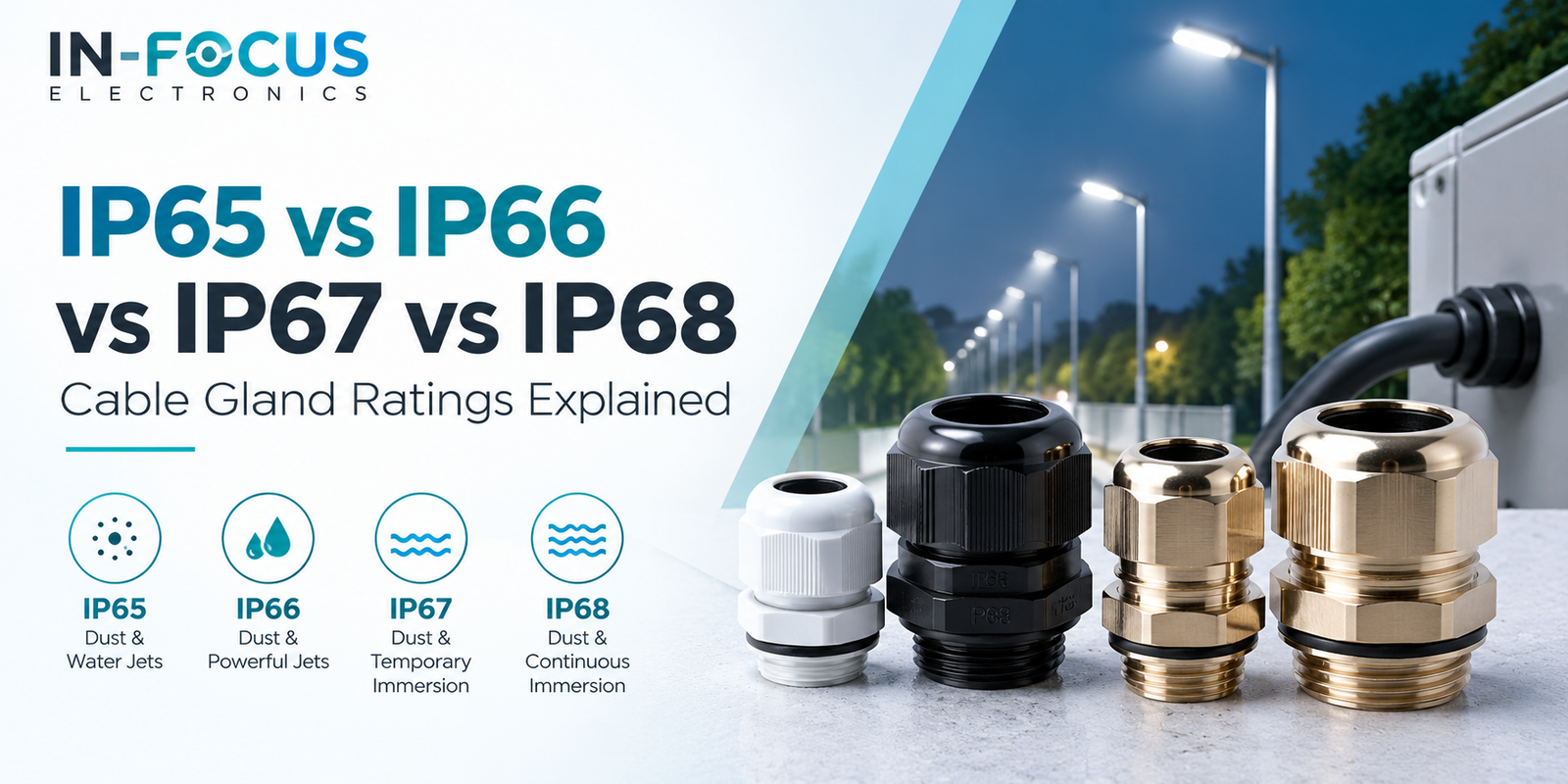
IP65 provides dust-tight protection and protection against water jets from any direction under the applicable test conditions.
Typical applications include outdoor LED lighting, electrical junction boxes, outdoor electrical enclosures and industrial equipment exposed to rain or water spray.
What Does IP66 Mean?
IP66 provides dust-tight protection and protection against powerful water jets. It may be suitable for outdoor lighting fixtures, industrial electrical enclosures, control panels and machinery exposed to demanding water-spray conditions.
IP66 does not automatically mean that the cable gland is suitable for immersion in water.
What Does IP67 Mean?
IP67 provides dust-tight protection and protection against temporary immersion in water under specified test conditions.
This rating may be suitable for certain ground-level lighting installations, outdoor electrical equipment exposed to temporary flooding and applications where temporary immersion is a foreseeable risk.
What Does IP68 Mean?
IP68 provides dust-tight protection and protection against continuous immersion in water under conditions specified by the manufacturer and applicable product requirements.
IP68 does not define one universal immersion depth or duration for every product. Always check the manufacturer's declared test conditions before selecting an IP68 cable gland.
IP65 vs IP66 vs IP67 vs IP68: Key Differences
IP RatingDust ProtectionWater ProtectionTypical Application Consideration
IP65Dust-tightWater jetsGeneral outdoor exposure IP66Dust-tightPowerful water jetsMore demanding water spray IP67Dust-tightTemporary immersionOccasional immersion risk IP68Dust-tightContinuous immersion under specified conditionsProlonged immersion applications
These ratings address different types of water exposure. A higher second digit does not automatically establish that every lower-rated water test has also been passed. Check the product's test documentation and suitability for the intended application.
Which IP Rating Is Best for Outdoor Cable Glands?
The correct rating depends on the installation environment and the type of water exposure.
- LED street lights and outdoor lighting: Consider IP65 or IP66 according to expected exposure and equipment requirements.
- Industrial control panels: Select a rating suitable for the installation environment and cleaning conditions.
- Ground-level electrical equipment: Consider whether standing water or temporary immersion is possible.
- Submerged equipment: An appropriately specified IP68 product may be required. Confirm the declared immersion conditions.
No single IP rating is best for every outdoor application. Choose according to the actual operating conditions and the protection required for the complete installation.
How to Choose the Right Cable Gland
1. Check Cable Diameter
Select a cable gland with a clamping range that matches the actual outer diameter of the cable. An incorrect fit can compromise sealing and cable retention.
2. Confirm Thread Size
Check the thread type and size, such as PG or metric. The cable gland must fit the enclosure opening correctly.
3. Check Sealing and Installation
Review the sealing washer, gasket, cable seal and installation instructions. Correct tightening and a suitable mounting surface are essential for achieving the intended protection.
4. Select the Appropriate Material
Brass, PVC and other cable gland materials may suit different applications. Consider corrosion exposure, temperature, mechanical requirements and compatibility with the equipment.
5. Verify the IP Rating
Check the manufacturer's technical documentation for the claimed IP rating and the conditions under which it applies. Do not assume that every cable gland offers the same protection.
6. Consider the Complete Enclosure
A high-rated cable gland alone does not guarantee that an entire lighting fixture or electrical enclosure is waterproof. The enclosure, cables, connectors, gaskets and all entry points must work together to provide the required protection.
Why Are IP-Rated Cable Glands Important for Outdoor Lighting?
Outdoor LED lighting systems face changing weather conditions. Rain, dust and moisture can affect electrical connections if cable entry points are not adequately protected.
A correctly selected cable gland helps secure the cable, seal the entry point and support the intended environmental protection of the lighting enclosure. For manufacturers of LED street lights, floodlights and industrial luminaires, cable gland selection is an important part of product design.
Explore Cable Glands at INFOCUS ELECTRONICS
INFOCUS ELECTRONICS supplies cable glands and lighting accessories for electrical equipment manufacturers, lighting businesses and industrial applications.
Before selecting a cable gland, confirm the required thread size, cable diameter, material and IP protection requirements.
Explore INFOCUS ELECTRONICS for cable glands and lighting accessories for your application.
Frequently Asked Questions
Is IP65 suitable for outdoor cable glands?
IP65 may be suitable for many outdoor applications involving dust and water jets. Suitability depends on the actual exposure conditions and the protection required by the complete installation.
What is the difference between IP65 and IP66?
Both ratings provide dust-tight protection. IP66 is designed for powerful water jets, while IP65 covers water jets under less demanding test conditions.
Is IP67 better than IP66?
Not in every situation. IP67 covers temporary immersion under specified conditions, whereas IP66 covers powerful water jets. The correct choice depends on the type of water exposure.
Does IP68 mean a cable gland can remain underwater forever?
No. IP68 applies under specified immersion conditions. Check the manufacturer's declared depth, duration and installation requirements.
Does an IP68 cable gland make an entire enclosure waterproof?
No. The complete enclosure assembly and every cable entry must meet the required protection level.
What is IEC 60529?
IEC 60529 is the international standard titled Degrees of protection provided by enclosures (IP Code). It defines the classification system used for IP protection ratings.
Conclusion
Understanding the IEC IP code makes it easier to select cable glands for outdoor lighting and electrical installations. IP65 and IP66 address water-jet exposure, while IP67 and IP68 address temporary and continuous immersion under specified conditions.
Always check cable diameter, thread size, sealing requirements, material compatibility and verified product ratings before choosing a cable gland.
INFOCUS ELECTRONICS supports lighting manufacturers and electrical businesses in identifying suitable cable gland options for their applications.