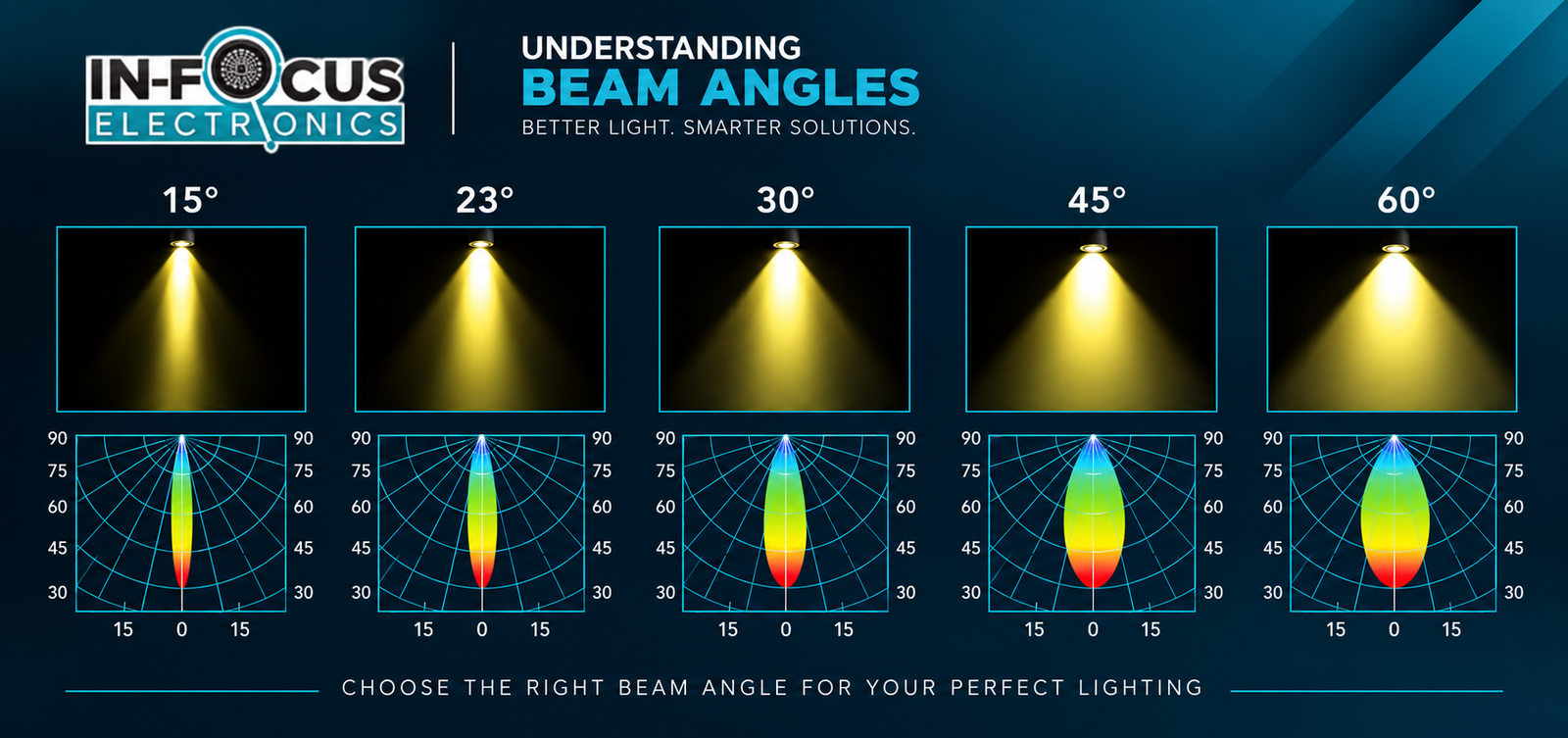
LED Lens Beam Angle Explained: 15°, 30°, 45°, 60°, 90° & 120° — Which Beam Angle Is Best?
When designing an LED lighting system, choosing the right LED optical lens beam angle is one of the most important decisions. The LED produces the light, but the optical lens controls how that light is distributed, focused, and spread across the target area.
A narrow beam can concentrate light over a smaller area, while a wider beam distributes light over a larger area. Selecting the wrong beam angle can result in dark spots, excessive brightness, glare, poor uniformity, or inefficient light distribution.
For OEMs, lighting manufacturers, project suppliers, and bulk buyers, understanding beam angles is essential when selecting an LED lens for street lights, flood lights, high bay lights, industrial lighting, and other LED applications.
In this guide, we explain the most commonly used LED lens beam angles — 15°, 30°, 45°, 60°, 90°, and 120° — and explain where each type is generally suitable.
---
What Is an LED Lens Beam Angle?
The beam angle describes how widely light is distributed from an LED optical lens.
In simple terms:
- Smaller beam angle = narrower and more concentrated light
- Larger beam angle = wider and more distributed light
For example, a 15° LED lens produces a much narrower light distribution than a 120° LED lens.
The correct beam angle depends on several factors, including:
- Mounting height
- Distance between the light and target surface
- Required illumination area
- LED power
- Lighting application
- Desired light uniformity
- Glare requirements
- Luminaire design
- Optical efficiency
Therefore, beam angle should not be selected based only on the angle itself. It should be considered as part of the complete optical design.
---
LED Lens Beam Angles at a Glance
| Beam Angle | Light Distribution | Typical Use | | ---------- | ------------------ | ----------------------------------------------------------- | | 15° | Very narrow | Spot lighting, accent lighting, long-distance illumination | | 30° | Narrow | Focused lighting, industrial and high mounting applications | | 45° | Medium-narrow | High bay and directional lighting | | 60° | Medium | High bay, industrial and area lighting | | 90° | Wide | Flood lighting, area lighting, general illumination | | 120° | Very wide | Broad-area illumination and low mounting heights |
These are general application guidelines. The ideal beam angle can vary depending on the luminaire design and photometric requirements.
---
15° LED Lens — Narrow Beam Lighting
A 15-degree LED lens creates a narrow and concentrated beam.
Because the light is focused into a relatively small area, it can be useful when illumination needs to reach a specific target or when the light source is installed at a greater distance from the target.
Typical applications
- Spot lighting
- Accent lighting
- Long-distance illumination
- Specialized industrial lighting
- Directional lighting
Advantages
- Concentrated light distribution
- Higher intensity in the target area
- Useful for long-distance applications
- Helps focus light where it is required
Considerations
A very narrow beam is not always suitable for general area lighting. Using a 15° lens where a broad distribution is required can create bright spots and poor uniformity.
---
30° LED Lens — Focused Directional Lighting
A 30-degree LED optical lens provides a broader distribution than a 15° lens while still maintaining relatively focused illumination.
It can be suitable when the lighting system requires directional illumination without concentrating the light as tightly as a very narrow beam.
Common applications
- Industrial lighting
- Directional luminaires
- High mounting applications
- Spot and accent lighting
- Specialized LED fixtures
For manufacturers, 30° lenses can provide a useful balance between concentration and coverage.
---
45° LED Lens — Balanced Beam Distribution
A 45-degree LED lens provides a medium-narrow beam and can be useful when both intensity and coverage are important.
It is often considered for applications where a very narrow beam would provide insufficient coverage but a wide beam would spread the light too much.
Potential applications
- High bay lighting
- Industrial lighting
- Warehouse lighting
- Directional LED fixtures
- Commercial lighting
The final result depends on the LED, lens geometry, mounting height, and luminaire design.
---
60° LED Lens — Versatile Industrial Lighting
A 60-degree LED lens provides a medium beam distribution and is commonly considered for applications requiring a balance between coverage and light intensity.
This type of beam can be particularly useful for lighting spaces where fixtures are installed at moderate to high mounting heights.
Typical applications
- LED high bay lights
- Industrial lighting
- Warehouse lighting
- Commercial areas
- General area illumination
For high bay applications, the correct beam angle can have a significant effect on floor-level illumination and uniformity.
---
90° LED Lens — Wide Area Illumination
A 90-degree LED lens produces a significantly wider light distribution.
Instead of concentrating light into a small area, it spreads the light across a larger region.
Common applications
- Flood lights
- Area lighting
- Industrial lighting
- Commercial lighting
- Outdoor illumination
- General-purpose LED fixtures
A wide beam can be useful when the objective is to cover a larger area with fewer concentrated hotspots.
However, wider distribution may also reduce peak intensity, so the mounting height and required illumination level should be considered.
---
120° LED Lens — Very Wide Light Distribution
A 120-degree LED lens provides a very broad distribution of light.
It can be useful when maximum coverage is more important than concentrating light into a narrow target area.
Typical applications
- Broad-area lighting
- Low mounting height applications
- General illumination
- Indoor lighting
- Specialized wide-beam LED fixtures
A 120° lens can help distribute light over a large area, but the optical design must be evaluated carefully to maintain the required illumination level and uniformity.
---
Narrow Beam vs Wide Beam LED Lenses
One of the simplest ways to understand beam angles is to compare narrow and wide distributions.
Narrow Beam — 15° to 30°
Narrow beam lenses generally:
- Concentrate light
- Produce higher intensity within the target area
- Cover a smaller area
- Can be useful for long-distance illumination
- Require careful aiming and optical design
Medium Beam — 45° to 60°
Medium beam lenses generally provide:
- A balance between intensity and coverage
- Useful area coverage
- Good flexibility for industrial applications
- Suitability for many high bay and commercial applications
Wide Beam — 90° to 120°
Wide beam lenses generally:
- Spread light over a larger area
- Provide broader coverage
- Can reduce concentrated hotspots
- Are useful for area and flood lighting
- Can be suitable for lower mounting heights
---
How Does Beam Angle Affect Lighting Coverage?
Beam angle has a direct relationship with the area illuminated by a fixture.
As the distance between the LED fixture and the target surface increases, the illuminated area produced by the same beam angle also becomes larger.
This means that a narrow beam can be useful for concentrating light at greater distances, while a wider beam can provide broad coverage at shorter distances.
For example, imagine two LED fixtures installed at the same height:
Fixture A: 30° beam Fixture B: 120° beam
The 30° lens will distribute light over a narrower area, while the 120° lens will spread the light much more widely.
Therefore, selecting the beam angle should always take the mounting height and required coverage area into account.
---
Beam Angle Is Not the Same as Light Output
An important point for LED lighting manufacturers is that beam angle and lumen output are not the same thing.
Lumens describe the total visible light output from a source or luminaire.
Beam angle describes how that light is distributed.
Two luminaires can have similar lumen output but produce very different illumination patterns because they use different optical lenses.
For example:
Luminaire A: 10,000 lumens with a narrow beam Luminaire B: 10,000 lumens with a wide beam
The total light output may be similar, but the light intensity and illuminated area can be very different.
This is why optical design is critical when developing an LED luminaire.
---
How to Choose the Right LED Lens Beam Angle
When selecting an optical lens, consider these key factors:
1. Mounting Height
Higher mounting heights may require a more focused optical distribution depending on the target illumination and spacing.
Lower mounting heights may benefit from wider distributions when broad coverage is required.
2. Required Coverage Area
Ask:
Do you need concentrated illumination or broad coverage?
For a small target area, a narrower beam may be appropriate.
For large areas, a wider beam may be more suitable.
3. LED Type
The lens must be compatible with the LED package and its physical dimensions.
Common LED configurations include:
- 3030 LED
- 3535 LED
- 5050 LED
Always verify compatibility before selecting the lens.
4. Luminaire Design
The optical lens works together with the LED, reflector, housing, PCB and other components.
The same beam-angle lens can perform differently in different luminaire designs.
5. Glare Requirements
Narrow, high-intensity distributions can create glare if not designed and aimed correctly.
For outdoor and industrial lighting, controlling glare and unwanted light spill is an important part of optical design.
6. Uniformity
Good lighting is not simply about producing high brightness.
The light should be distributed appropriately across the required area.
The right lens can help improve uniformity and reduce unwanted bright and dark areas.
---
Why LED Optical Lens Design Matters for OEMs
For an LED lighting manufacturer, the optical lens is more than an accessory.
It is an important part of the luminaire's optical system.
The right lens can help manufacturers achieve:
- Controlled light distribution
- Better illumination uniformity
- Reduced unwanted light spill
- Improved application-specific performance
- Better optical control
- More consistent luminaire performance
This is especially important when developing products for different applications such as street lighting, flood lighting, high bay lighting, industrial lighting, and commercial illumination.
---
Common Mistakes When Selecting an LED Lens
Choosing a beam angle only because it is popular
There is no single beam angle that is best for every application.
Ignoring mounting height
The same lens can produce very different coverage at different mounting heights.
Ignoring LED compatibility
A lens should be designed for the intended LED package and dimensions.
Focusing only on lumens
Total lumen output does not tell you how effectively light will be distributed.
Not checking the actual optical performance
For professional lighting projects, photometric testing and optical evaluation are important before finalizing a lens.
---
How Infocus Electronics Can Help
At Infocus Electronics, we supply LED optical lenses for lighting manufacturers, OEMs, distributors, and bulk buyers.
Our LED optical lens range can be considered for applications including:
- Street lights
- Flood lights
- High bay lights
- Industrial lighting
- Commercial lighting
- Outdoor LED lighting
- Specialized LED luminaires
We offer optical solutions designed for different LED packages, beam distributions, and luminaire requirements.
For manufacturers developing a new LED fixture or looking for a replacement optical lens, selecting the correct combination of LED compatibility, beam angle, dimensions, material, and optical distribution is essential.
---
Frequently Asked Questions About LED Lens Beam Angles
Which LED lens beam angle is best?
There is no universal best beam angle. The correct choice depends on mounting height, coverage area, LED type, luminaire design, required illumination, and desired light distribution.
What is a 15-degree LED lens used for?
A 15° lens provides a narrow and concentrated beam and can be considered for spot, accent, directional, and long-distance lighting applications.
What is a 60-degree LED lens used for?
A 60° lens provides a medium distribution and can be suitable for high bay, industrial, warehouse, and general area lighting applications.
What is a 90-degree LED lens used for?
A 90° lens provides a wide distribution and can be considered for flood lights, area lighting, commercial lighting, and outdoor applications.
What is a 120-degree LED lens used for?
A 120° lens provides a very wide distribution and can be useful when broad light coverage is required.
Is a narrow beam better than a wide beam?
Not necessarily. A narrow beam is better when concentrated illumination is required, while a wide beam is generally more suitable when broad coverage is the priority.
Can one LED lens be used for different applications?
Some optical lenses can be used across multiple applications, but the suitability depends on the LED package, luminaire design, beam distribution, mounting conditions, and required photometric performance.
---
Final Thoughts
The LED lens beam angle plays a major role in controlling how light reaches the target area.
Whether you are designing a street light, flood light, high bay, industrial luminaire, or another LED lighting product, selecting the appropriate beam distribution can help achieve better optical control and more effective illumination.
From 15° narrow beam lenses to 120° wide beam lenses, every beam angle has a different purpose.
The best choice is not simply the widest or narrowest lens — it is the lens that matches the LED, mounting height, coverage requirement, luminaire design, and intended application.
If you are an OEM, lighting manufacturer, distributor, or bulk buyer looking for LED optical lenses, Infocus Electronics can help you identify a suitable optical solution for your lighting application.
Need an LED optical lens for your project? Contact IN-Focus Electronics for product specifications, samples, and bulk supply.