How to Select LED Lenses for Flood Lights and High Bay Lights
Choosing the right LED lens is an important step in designing an effective flood light or high bay lighting system. Although LED chips generate light, optical lenses help direct that light toward the required area and create a suitable illumination pattern.
The correct lens can help lighting manufacturers achieve the desired coverage, manage light distribution, and design fixtures for specific installation conditions.
For LED lighting manufacturers, OEMs, electrical product companies, and lighting designers, understanding lens selection is essential for developing suitable lighting solutions.
In this guide, we explain the important factors to consider when selecting LED optical lenses for flood lights and high bay lights.
What Is an LED Optical Lens?
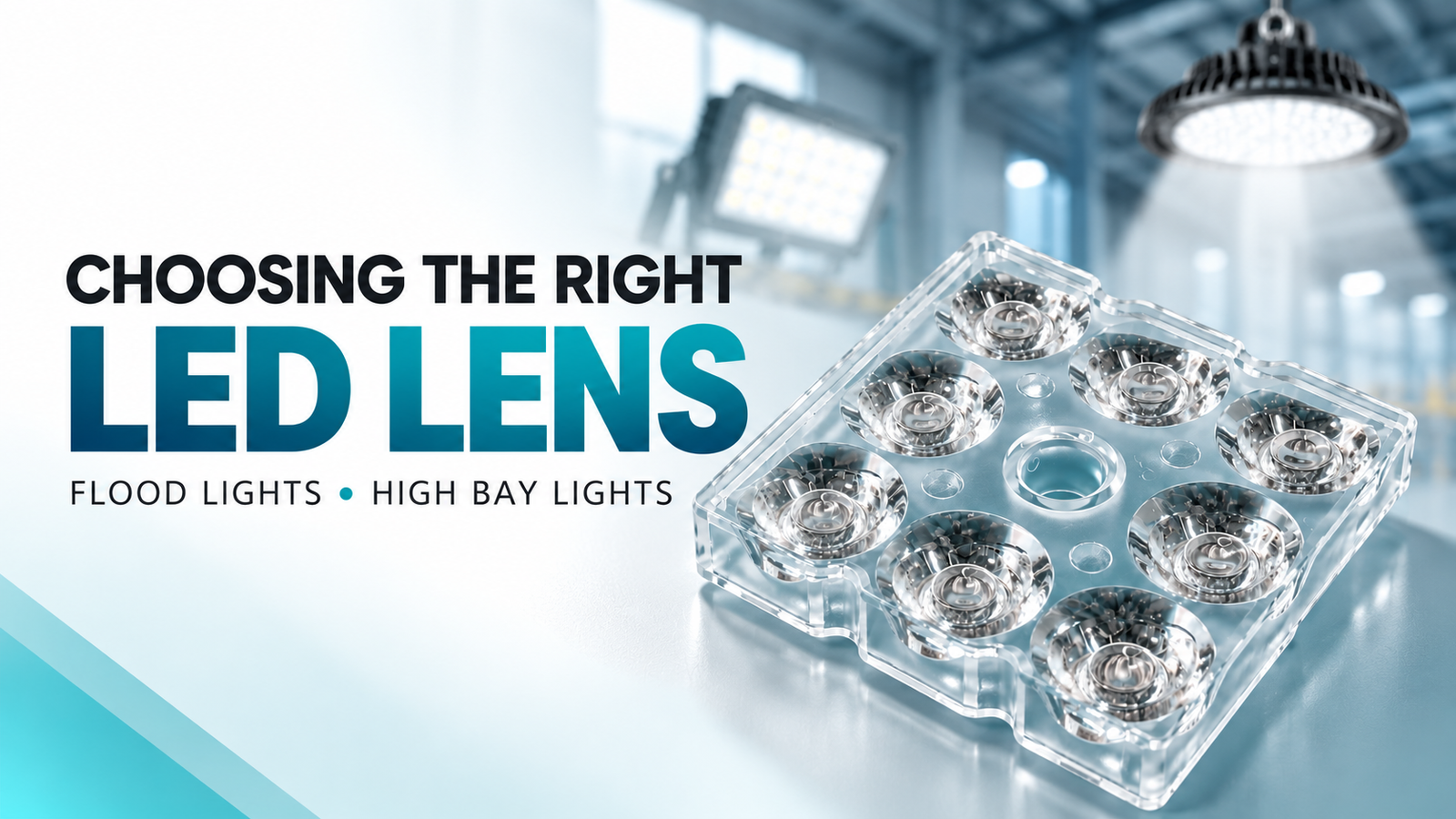
An LED optical lens is a transparent optical component designed to control the direction and distribution of light emitted by an LED.
Depending on its geometry and optical properties, a lens can concentrate light into a relatively narrow beam, spread it across a wider area, or create a specialised distribution pattern.
LED lenses are available in different sizes, shapes, beam angles, and configurations. Some are designed for individual LEDs, while others contain multiple optical elements for LED arrays.
The correct lens must be compatible with the LED package, PCB layout, fixture design, and intended application.
Why Is Lens Selection Important?
Selecting an appropriate LED lens helps manufacturers match the light distribution to the requirements of the installation.
Important benefits can include:
- Directing light toward the intended area.
- Helping achieve the desired illumination pattern.
- Supporting more uniform light distribution when correctly designed.
- Reducing unwanted light spill in suitable optical configurations.
- Matching the fixture's optical performance to the application.
A lens does not create additional light. Its role is to control the direction and distribution of the light produced by the LED.
Actual lighting performance depends on the complete luminaire, including the LED, driver, optics, thermal design, mounting position, and installation environment.
How to Select LED Lenses for Flood Lights
Flood lights are used in outdoor spaces, industrial yards, building exteriors, parking areas, sports facilities, and other locations where a target area needs illumination.
When choosing a floodlight lens, consider the following factors.
1. Determine the Required Coverage Area
Start by identifying the dimensions and shape of the area that needs to be illuminated.
A relatively narrow distribution may suit a distant target or a specific section of an area. A wider distribution may be more appropriate when broad coverage is required.
However, the best choice depends on mounting height, fixture aiming, LED output, and the required illumination level.
2. Select a Suitable Beam Angle
Beam angle affects how widely light spreads from the fixture.
Narrower beams concentrate light over a smaller angular region, while wider beams spread light across a larger region.
For flood lighting, the appropriate beam distribution depends on the distance to the target, the required coverage, and the arrangement of the fixtures.
Do not select a lens based on beam angle alone. Review available photometric data to understand the actual light distribution.
3. Consider Mounting Height and Distance
Mounting height influences the illuminated footprint and the amount of light reaching the target.
As the distance between a light source and a target increases, the illuminated area generally becomes larger for a given beam distribution, and illuminance decreases.
Choose optics based on the actual installation height and distance rather than relying only on the lens appearance or nominal beam angle.
4. Check LED and Lens Compatibility
Confirm that the lens is designed for the LED package and arrangement used in the fixture.
Check the package format, optical centre, LED spacing, mounting method, and mechanical dimensions.
A lens that does not align correctly with the LED may produce unexpected light distribution or reduced optical performance.
How to Select LED Lenses for High Bay Lights
High bay lights are commonly installed in warehouses, factories, workshops, distribution centres, and other buildings with high ceilings.
Their optical systems need to distribute light across floors, aisles, storage racks, and work areas.
1. Consider Ceiling Height
The mounting height is one of the most important factors in selecting high bay optics.
The required beam distribution may differ between a lower ceiling and a substantially higher installation.
Evaluate the mounting height together with fixture spacing, required illuminance, and the dimensions of the space.
2. Match the Lens to the Layout
Different buildings have different lighting requirements.
For example, an aisle-based warehouse may need a distribution suited to long, narrow aisles. An open manufacturing floor may require a different distribution to achieve suitable coverage.
The lens should support the lighting layout rather than being selected independently of the building design.
3. Review Light Uniformity
Good lighting design considers more than the brightness directly below a fixture.
The objective is to achieve appropriate illumination across the working area while limiting excessively bright spots and dark regions.
Lens distribution, fixture spacing, mounting height, and LED output all influence the final result.
Photometric simulations can help determine whether the selected lens is appropriate before the lighting system is installed.
4. Consider Glare and Visual Comfort
A poorly matched optical distribution can create uncomfortable bright areas, particularly when fixtures are mounted within the field of view.
Consider the working environment, viewing directions, fixture mounting position, and the optical design when selecting high bay lenses.
Suitable optics should be evaluated as part of the complete luminaire design.
Narrow Beam vs Wide Beam LED Lenses
The following comparison provides a general starting point.
Narrow beam lenses
- Concentrate light into a smaller angular region.
- May suit longer throw distances or more focused illumination.
- Require careful aiming and coverage planning.
Wide beam lenses
- Spread light over a larger angular region.
- May suit broader coverage and certain lower mounting heights.
- Can require more careful evaluation when greater throw distance is needed.
Neither option is universally better. The appropriate choice depends on the installation and the required photometric performance.
Why LED Package Compatibility Matters
LED optical lenses are manufactured for different LED packages and PCB configurations.
Common package formats include 3030, 3535, and 5050, among others.
Before selecting a lens, verify:
- LED package and emitting area.
- Lens dimensions and optical alignment.
- Number and spacing of LEDs.
- PCB arrangement and mechanical fit.
- Required beam distribution.
- Compatibility with the fixture housing.
Even lenses with similar external dimensions can have different optical designs. Confirm compatibility with the specific LED and lens model.
Important Technical Factors to Check
Before finalising an LED lens for floodlight or high bay production, review these specifications.
Beam distribution: Confirm that the optical pattern suits the target area and installation geometry.
Optical efficiency: Check available data showing how much light passes through the optical component.
Material: Consider the optical material's temperature limits, environmental suitability, and compatibility with the fixture.
Mechanical dimensions: Verify mounting points, clearances, lens height, and alignment with the LED PCB.
Thermal conditions: Ensure the lens material and fixture design are suitable for the expected operating temperature.
Photometric performance: Where available, review photometric files, intensity distribution, and lighting simulations.
Environmental requirements: Consider dust, moisture, UV exposure, and other conditions relevant to the installation.
These checks help reduce compatibility issues during fixture development and testing.
Common Mistakes to Avoid When Choosing LED Lenses
Avoid these common lens-selection mistakes:
- Choosing a lens based only on its advertised beam angle.
- Ignoring mounting height and the dimensions of the target area.
- Using a lens that is incompatible with the LED package.
- Assuming that a narrower beam always provides better lighting.
- Ignoring glare, light spill, and illumination uniformity.
- Overlooking temperature and environmental requirements.
- Selecting optics without evaluating the complete lighting fixture.
A well-chosen lens should match the real application and be validated using suitable optical and photometric information.
Frequently Asked Questions
Which LED lens is best for flood lights?
The best lens depends on the target area, mounting height, required coverage, LED configuration, and desired light distribution. Review the lens's optical specifications before making a selection.
Which LED lens is suitable for high bay lights?
High bay lens selection depends on ceiling height, fixture spacing, aisle layout, required illumination, and glare considerations. The optical distribution should match the space being illuminated.
Does a narrow beam provide more brightness?
A narrow beam can concentrate light into a smaller angular region, increasing intensity in particular directions. However, overall performance depends on the LED output, optical efficiency, aiming, and distance to the target.
Can one LED lens be used for both flood lights and high bay lights?
Some optical designs may be suitable for more than one application, but suitability must be checked against the required beam pattern, installation conditions, LED package, and fixture design.
How do I check whether an LED lens fits my LED?
Check the LED package, optical centre, dimensions, PCB layout, and the lens manufacturer's compatibility information. A physical fit alone does not guarantee the intended optical performance.
What information should I provide when buying LED lenses?
Provide the LED package type, number of LEDs, PCB arrangement, intended application, mounting height, desired beam distribution, and any available mechanical dimensions. These details help identify suitable optical options.
Looking for LED Optical Lenses for Flood Lights and High Bay Lights?
INFOCUS ELECTRONICS supplies LED optical lenses and lighting components for lighting manufacturers, OEMs, traders, and other businesses.
If you are developing flood lights, high bay fixtures, or other LED lighting products, selecting compatible optics is an important part of achieving the desired light distribution.
Contact INFOCUS ELECTRONICS to discuss your LED lens requirements, available models, LED compatibility, and bulk purchasing enquiries.
Website: https://www.infocuselectronics.com/
Conclusion
Selecting the right LED lens for flood lights and high bay lights requires more than choosing a beam angle. Mounting height, coverage area, LED package compatibility, optical efficiency, glare, and the complete fixture design must all be considered.
By evaluating these factors and checking the relevant technical specifications, lighting manufacturers can make more informed decisions when selecting optics for their applications.
For LED optical lens requirements and product enquiries, contact INFOCUS ELECTRONICS.