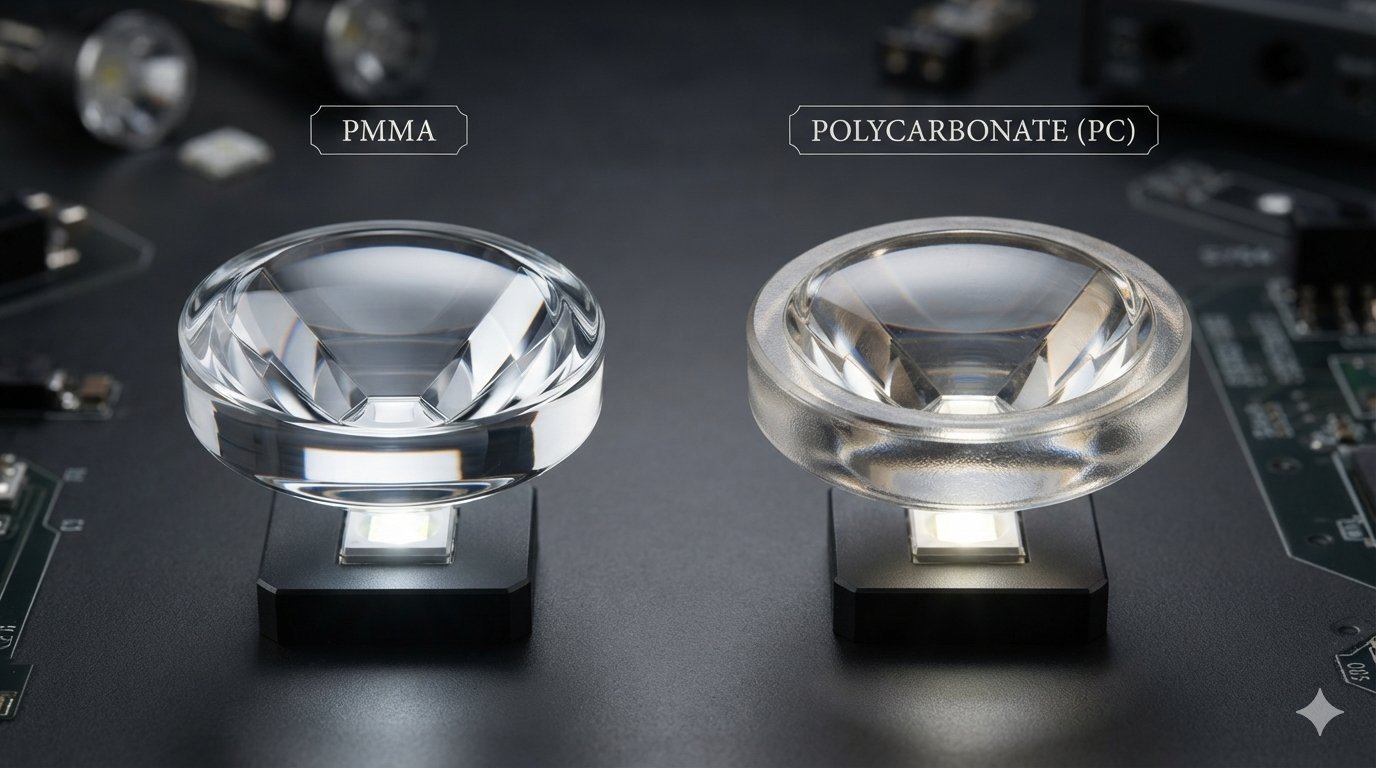
LED Lens Material - PMMA vs Polycarbonate: Which Is Better?
Selecting the right material for an LED optical lens is an important part of designing a reliable and efficient LED lighting system. The material used for the lens can influence optical clarity, light transmission, heat resistance, impact strength, UV stability, durability and overall performance.
Two of the most commonly used materials for LED optical lenses are PMMA (Polymethyl Methacrylate) and Polycarbonate (PC).
Both materials can be precision moulded into optical lenses for different LED lighting applications. However, their characteristics are different, and the right choice depends on the type of luminaire, operating temperature, installation environment and required optical performance.
What Is PMMA?
PMMA, commonly known as acrylic, is a transparent thermoplastic widely used in optical and lighting applications.
PMMA is particularly well known for its excellent optical clarity and high light transmission. It can be manufactured into precision optical geometries that control and distribute LED light according to the required beam pattern.
PMMA is also naturally resistant to UV exposure compared with standard polycarbonate, making it suitable for applications where long-term optical appearance and clarity are important.
Advantages of PMMA LED Lenses
One of the biggest advantages of PMMA is its high optical transparency. A good-quality PMMA optical lens can provide excellent light transmission, helping reduce optical losses in the lighting system.
PMMA also provides excellent visual clarity and is suitable for applications where the appearance of the optical component is important.
Another advantage is its good UV stability. This makes suitable PMMA grades useful for outdoor lighting applications where the lens is exposed to sunlight and environmental conditions.
PMMA also generally has a harder surface than standard polycarbonate, which can provide better resistance to everyday surface scratching.
Because PMMA can be precision moulded, it can be used to manufacture different LED optical designs, including narrow-beam, wide-beam, street-light and other secondary optical lenses.
What Is Polycarbonate?
Polycarbonate, commonly abbreviated as PC, is an engineering thermoplastic known for its combination of optical transparency, toughness and thermal performance.
Polycarbonate LED lenses are widely used where the optical component needs to withstand mechanical impact, vibration, handling and higher operating temperatures.
The major advantage of PC is its excellent impact resistance. Compared with PMMA, polycarbonate is considerably tougher and is less likely to crack or break under mechanical impact.
This makes PC particularly attractive for industrial and outdoor LED lighting applications.
Advantages of Polycarbonate LED Lenses
The high impact resistance of polycarbonate makes it suitable for lighting fixtures that may experience mechanical stress during transportation, installation or operation.
PC also generally provides better heat resistance than PMMA. This can be important in high-power LED luminaires where heat generated by the LED and surrounding components can raise the temperature around the optical lens.
Polycarbonate can also be precision moulded into complex optical profiles, allowing manufacturers to produce lenses for different beam angles and LED packages.
With the correct UV-stabilized material grade, PC can also be used in outdoor lighting applications.
PMMA vs Polycarbonate for LED Optical Lenses
When comparing PMMA and polycarbonate, there is no single material that is best for every LED application.
PMMA is often preferred when optical clarity, high light transmission, UV stability and surface appearance are major priorities.
Polycarbonate is often preferred when impact resistance, toughness and higher temperature resistance are more important.
For example, PMMA can be considered for applications where the optical component is protected from significant mechanical impact and where maximum optical clarity is required.
Polycarbonate can be a better choice for applications where the luminaire operates in a demanding environment or where the lens may experience mechanical impact.
Light Transmission of PMMA and Polycarbonate
Optical transmission is an important consideration when selecting an LED lens material.
PMMA generally provides very high visible-light transmission and is commonly selected for applications where maximum optical efficiency is desired.
Clear polycarbonate also provides good optical transmission, although its transmission can be somewhat lower than PMMA depending on the specific material grade.
However, material transmission is only one part of the overall optical performance.
The lens geometry, optical design, LED package, surface finish, moulding accuracy and material quality can have a significant effect on the final beam distribution and efficiency of an LED luminaire.
Therefore, simply selecting a material with higher transmission does not automatically guarantee better lighting performance.
Heat Resistance: PMMA vs PC
Heat management is especially important in high-power LED lighting.
LEDs generate heat during operation, and the temperature around the secondary optical lens can increase depending on the luminaire design, LED power, heatsink performance and ambient conditions.
Polycarbonate generally provides better thermal resistance than PMMA, making it an attractive option for applications where the optical lens may be exposed to higher operating temperatures.
PMMA can still be used successfully in many LED lighting applications when the thermal design keeps the lens within its recommended operating conditions.
The actual temperature limit should always be checked against the technical data of the selected material grade rather than relying only on general material specifications.
UV Resistance and Outdoor LED Lighting
UV exposure is another important consideration for outdoor LED luminaires.
PMMA has good inherent resistance to UV radiation and is therefore widely used in applications where long-term optical clarity is required.
Standard polycarbonate can be more sensitive to UV exposure. However, UV-stabilized polycarbonate grades are available and can significantly improve outdoor durability.
For outdoor applications such as street lights, flood lights and industrial luminaires, the material grade should therefore be selected according to the expected environmental exposure.
Impact Resistance
Impact resistance is one of the clearest differences between PMMA and polycarbonate.
PMMA is relatively rigid and provides good optical performance, but it is more susceptible to cracking or breaking under significant impact.
Polycarbonate is considerably tougher and provides much higher impact resistance.
For this reason, PC is often considered when LED lenses are required for rugged environments, industrial lighting fixtures, outdoor installations or applications where mechanical damage is a concern.
Which Material Should You Choose?
The best LED lens material depends on the application.
If your priority is high optical clarity, excellent light transmission, UV stability and surface appearance, PMMA can be an excellent choice.
If your priority is impact resistance, toughness and better thermal performance, polycarbonate may be more suitable.
For high-power outdoor lighting, the decision should also consider LED junction temperature, heatsink design, ambient temperature, UV exposure and the exact grade of optical material.
PMMA or PC for LED Street Light Lenses?
LED street lights are exposed to outdoor environmental conditions, temperature variations, dust, moisture and potential mechanical impact.
Both PMMA and PC can be used for street-light optical systems, provided the material grade and lens design are appropriate for the application.
PMMA can provide excellent optical performance and UV stability, while polycarbonate can provide additional toughness and impact resistance.
The final selection should therefore be based on the complete luminaire design rather than material selection alone.
PMMA or PC for LED Flood Lights and High Bays?
Flood lights and high-bay lights can operate at relatively high power and may be exposed to elevated temperatures.
Polycarbonate can be advantageous where higher thermal resistance and mechanical toughness are required.
PMMA can be considered where optical performance, clarity and UV stability are more important and the thermal environment is properly controlled.
Why Lens Quality Matters More Than Material Alone
Choosing PMMA or polycarbonate is only the first step.
The performance of an LED optical lens also depends on:
- Optical design
- Beam angle
- LED compatibility
- Material grade
- Lens dimensions
- Moulding precision
- Surface quality
- Thermal conditions
- UV exposure
- Installation environment
A high-quality optical lens manufactured from the correct material can provide significantly better results than an incorrectly designed lens made from a theoretically better material.
Conclusion
PMMA and polycarbonate are both valuable materials for LED optical lens manufacturing.
PMMA is a strong choice when excellent optical clarity, high light transmission, UV stability and surface appearance are important.
Polycarbonate is a strong choice when impact resistance, toughness and higher temperature performance are required.
There is no universal winner between PMMA and PC. The correct material should be selected according to the LED application, operating temperature, environmental conditions, optical requirements and expected service life.
At Infocus Electronics, LED optical lenses can be selected according to different lighting requirements, including street lighting, flood lighting, high-bay lighting and other LED applications. Selecting the correct lens geometry and material is essential for achieving the required beam distribution and reliable long-term performance.