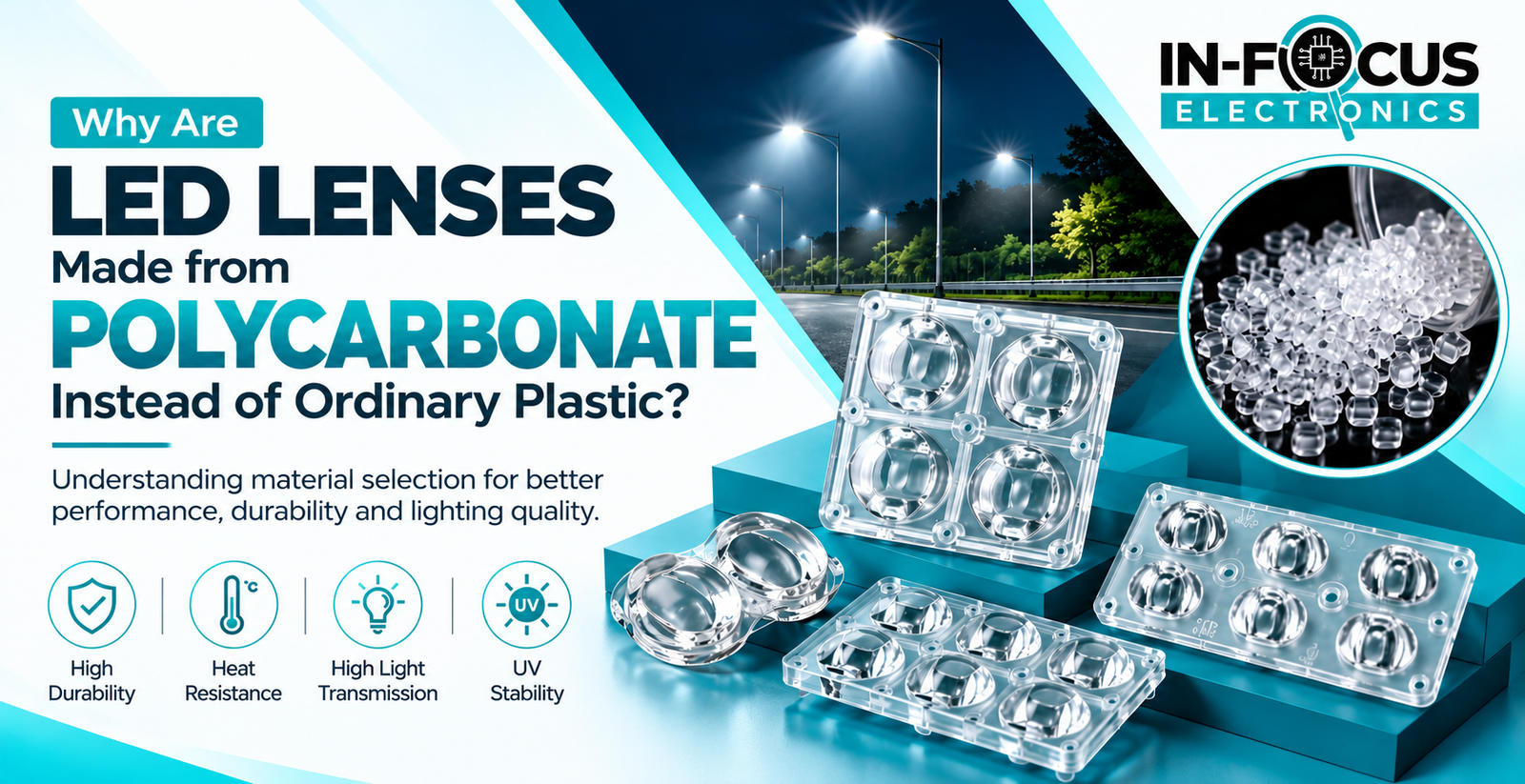
Why Are LED Lenses Made from Polycarbonate Instead of Ordinary Plastic?
LED lenses play an important role in modern lighting systems. They help control the direction, distribution, and spread of light produced by LEDs. From street lights and flood lights to high-bay luminaires and industrial lighting, the right lens material can influence optical performance, durability, and product reliability.
Polycarbonate (PC) is widely used for LED lenses because it offers a useful combination of impact resistance, design flexibility, and heat resistance. However, it is not the only option. Optical-grade PMMA (polymethyl methacrylate), also known as acrylic, can be an excellent choice for applications that prioritize optical clarity and weather resistance.
So, why do lighting manufacturers choose polycarbonate instead of ordinary plastic? Let's explore the main differences.
1. What Makes Polycarbonate Suitable for LED Lenses?
Polycarbonate is an engineering thermoplastic used in applications where toughness, dimensional stability, and heat resistance are important. When manufactured in an appropriate optical grade, it can be used to produce LED lenses with carefully designed beam angles and light distribution patterns.
- High impact resistance: Polycarbonate is generally more impact-resistant than PMMA and many conventional plastics.
- Heat resistance: Suitable optical grades can withstand elevated temperatures, subject to the material specification and actual operating conditions.
- Optical design flexibility: The material can be moulded into lens shapes that help control beam angles and light distribution.
- Lightweight construction: PC lenses can help reduce the weight of a lighting assembly compared with some alternative materials.
- Manufacturing versatility: Injection moulding can support the production of complex optical profiles and repeated lens designs.
It is important to select optical-grade polycarbonate rather than assuming that every type of PC provides the same transparency, UV stability, or optical performance.
2. Polycarbonate vs PMMA vs Ordinary Plastic
Polycarbonate and PMMA are both used in lighting applications, but their properties differ. Ordinary plastic is a broad term that includes many materials, so its performance depends on the specific polymer and grade.
Property Optical-Grade PC Optical-Grade PMMA Ordinary Plastic
Impact resistance Generally very high Generally lower than PC Varies by material
Heat resistance Generally good Grade-dependent; generally lower than PC Varies considerably
Optical clarity Very good in suitable grades Excellent in suitable grades Depends on the polymer and quality
UV and weather resistance Depends on UV stabilization and grade Generally very good Depends on formulation
Lens design Suitable for complex optical shapes Suitable for precise optical shapes Depends on material and manufacturing process
Best selection factor Toughness and heat performance Optical clarity and weathering performance Application-specific cost and performance
There is no single material that is best for every LED lens. The correct choice depends on the optical design, operating temperature, outdoor exposure, mechanical requirements, and overall product specifications.
3. Does Polycarbonate Improve LED Light Transmission?
Polycarbonate can provide high light transmission when an appropriate optical grade and surface finish are used. However, choosing PC does not automatically guarantee better light transmission than PMMA.
The amount of light passing through a lens depends on several factors:
- The optical properties and quality of the material.
- The thickness and surface finish of the lens.
- The lens geometry and internal optical structure.
- The wavelength of the LED light.
- The presence of scratches, contamination, or surface defects.
For lighting manufacturers, total transmission is only one consideration. A lens must also distribute light correctly for its intended application, whether that is a narrow beam for high-bay lighting or a controlled asymmetric distribution for street lighting.
4. How Does Heat Resistance Affect LED Lens Selection?
LED lighting systems generate heat, and the temperature experienced by a lens depends on the LED power, heat-sink design, enclosure, ambient temperature, and distance between the LED and the optical component.
Polycarbonate is often selected when a lens needs a combination of impact resistance and heat performance. Nevertheless, the allowable operating temperature must be checked against the technical datasheet of the exact grade.
Excessive heat can contribute to discoloration, deformation, changes in optical performance, or premature component failure. Proper thermal management and material selection are therefore essential for reliable lighting products.
5. Is Polycarbonate Better for Outdoor LED Lighting?
Polycarbonate can be a suitable material for outdoor LED lenses used in street lights, flood lights, and other exterior luminaires. Its impact resistance can be particularly valuable where components may experience mechanical stress.
Outdoor suitability also depends on UV exposure, temperature cycling, moisture protection, and the design of the complete luminaire. UV-stabilized grades or appropriate protective measures may be required to maintain long-term performance.
PMMA can also be suitable for outdoor applications, particularly where strong weathering performance and optical clarity are priorities. Manufacturers should compare the specific material grades and application requirements before making a decision.
6. Which LED Lens Material Should Manufacturers Choose?
The following selection guide can help lighting manufacturers narrow down their options:
- Choose optical-grade PC when impact resistance, suitable heat performance, and complex moulded optical designs are important.
- Consider optical-grade PMMA when optical clarity and weathering performance are key priorities and the mechanical and thermal requirements can be met.
- Evaluate other plastics carefully when cost is a major factor. Confirm that the selected material meets the required optical, thermal, mechanical, and environmental specifications.
Before finalizing a material, review its technical datasheet and, where possible, test the finished lens in the actual lighting assembly. Check light distribution, transmission, temperature performance, and durability under the expected operating conditions.
7. Why Is the Right LED Lens Important for Lighting Performance?
An LED lens does more than cover a light source. Its optical geometry helps determine how light is distributed across a road, warehouse floor, outdoor area, or industrial workspace.
A correctly selected lens can help lighting manufacturers achieve their intended beam pattern, reduce unwanted light spill, and improve illumination uniformity. The lens material, optical design, LED package, and mounting arrangement must all work together to deliver the desired result.
Explore our LED optical lens range to learn more about lens options for different lighting applications.
Frequently Asked Questions
Why is polycarbonate used in LED lenses?
Polycarbonate is used because suitable optical grades offer a combination of impact resistance, heat performance, and flexibility for producing complex lens designs.
Is polycarbonate better than acrylic for LED lenses?
Neither material is universally better. PC generally offers higher impact resistance, while PMMA often offers excellent optical clarity and weathering performance. The correct choice depends on the application and material grade.
Does a polycarbonate LED lens turn yellow over time?
Some polycarbonate grades can discolor after prolonged exposure to UV radiation, heat, or unsuitable environmental conditions. UV-stabilized grades and proper thermal design can help reduce this risk, but performance should be verified for the intended application.
Can polycarbonate withstand high temperatures?
Polycarbonate generally has good heat resistance compared with many common plastics, but its maximum service temperature depends on the exact grade, exposure duration, mechanical loading, and operating environment.
What should manufacturers check before purchasing LED lenses?
Manufacturers should check the beam angle, optical distribution, material grade, dimensions, LED compatibility, temperature limits, light transmission, UV requirements, and suitability for the intended luminaire.
Conclusion
Polycarbonate is a popular choice for LED lenses because it combines toughness, useful heat resistance, and optical design flexibility. However, PMMA and other engineered materials can be better suited to certain lighting applications.
For lighting manufacturers and OEMs, the best approach is to select a material based on verified technical specifications and the operating requirements of the finished product rather than choosing by material name alone.
Visit INFOCUS ELECTRONICS to explore lighting components and optical lens solutions for LED lighting applications.