What Happens If You Use the Wrong Silicone Potting Compound for LED Drivers?
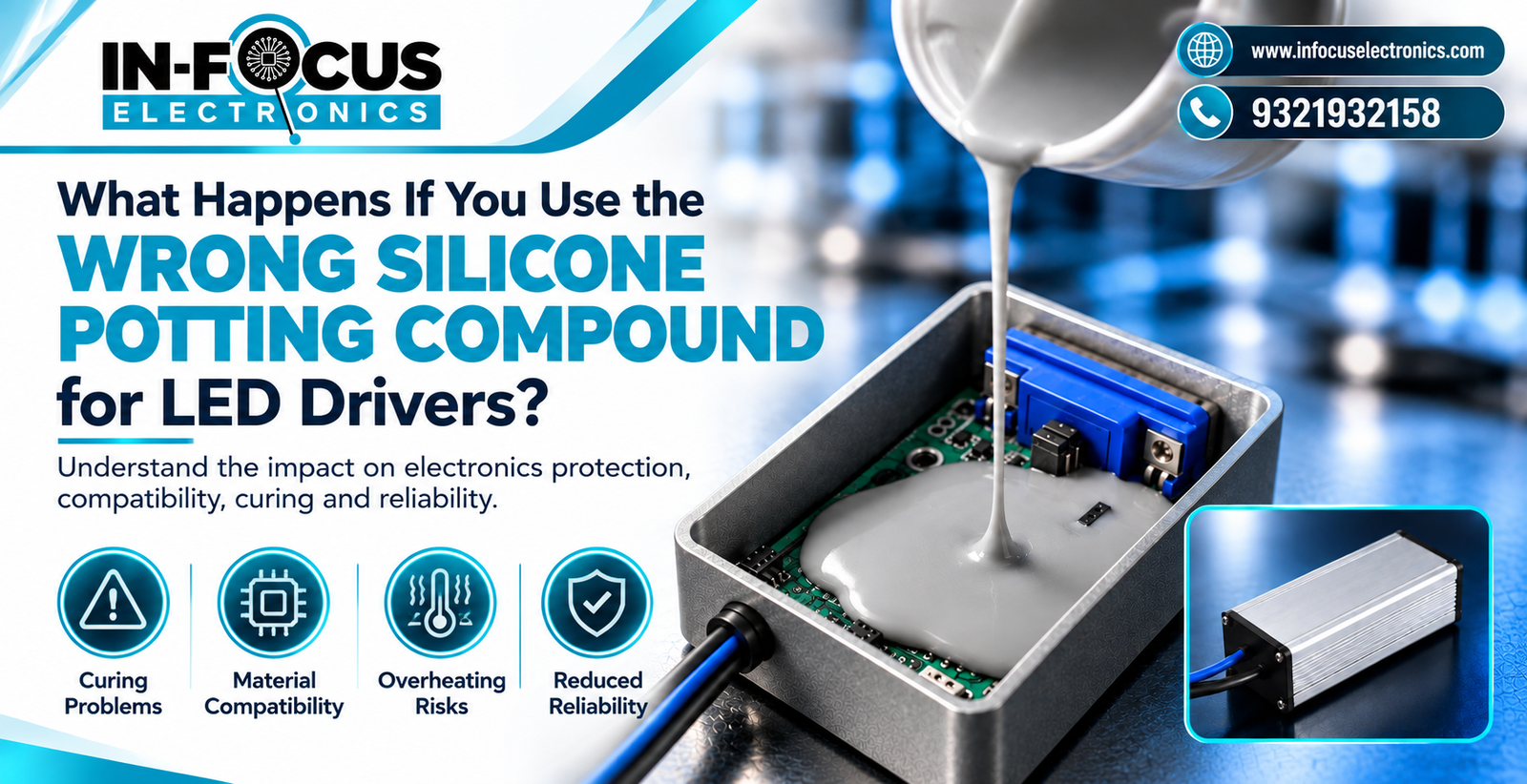
LED drivers are essential components in LED lighting systems. They regulate the electrical power supplied to LEDs and help maintain stable lighting performance. In many applications, manufacturers use silicone potting compounds to protect driver electronics against moisture, dust, vibration, and environmental stress.
However, not every silicone potting compound is suitable for every LED driver. Choosing an incompatible material can lead to incomplete curing, poor bonding, excessive heat retention, electrical performance issues, or premature product failure.
So, what happens when the wrong silicone potting compound is used, and how can manufacturers avoid these problems? This guide explains the key risks and the factors to check before selecting a potting material.
1. Why Is Silicone Potting Compound Used in LED Drivers?
Silicone potting compound is used to encapsulate electronic components within a housing or enclosure. Once properly cured, a suitable formulation can create a protective barrier around sensitive electronics.
Depending on the product formulation, silicone potting compounds can offer several benefits:
- Moisture protection: Helps reduce exposure of electronic components to moisture when used as part of a properly designed enclosure.
- Electrical insulation: Suitable formulations provide electrical insulation around components and connections.
- Thermal performance: Some formulations are designed to transfer heat away from heat-generating components.
- Vibration protection: Flexible cured silicone can help reduce mechanical stress on sensitive components.
- Temperature flexibility: Many silicone formulations retain flexibility over a broad temperature range, depending on the grade.
These benefits depend on the material specification, application method, curing process, and overall LED driver design. Potting alone does not guarantee waterproofing or reliable operation.
2. What Happens If You Choose the Wrong Silicone Potting Compound?
A. The Compound Does Not Cure Properly
One of the most common problems is incomplete or delayed curing. The silicone may remain sticky, soft, or liquid in certain areas instead of developing the expected cured properties.
This can happen when the wrong curing system is selected, the mixing ratio is incorrect for a two-part product, the material is contaminated, or the curing conditions are unsuitable.
How to prevent it: Follow the manufacturer's instructions for mixing, application, temperature, and curing time. Check whether the product is a one-part or two-part system and verify its compatibility with the materials present in the assembly.
B. The Compound Does Not Adhere Properly
Poor adhesion can leave gaps between the potting material and the enclosure or electronic components. These gaps may allow moisture or contaminants to reach sensitive areas, depending on the construction of the assembly.
Adhesion problems can result from surface contamination, incompatible substrates, unsuitable silicone chemistry, or inadequate surface preparation.
How to prevent it: Clean and prepare surfaces according to the product datasheet. Where necessary, test adhesion on the actual PCB, enclosure, wire insulation, and connector materials before full production.
C. Heat Dissipation Becomes a Problem
LED drivers contain components that generate heat during operation. A potting compound with unsuitable thermal conductivity or an inappropriate application thickness can contribute to thermal management problems.
Not all silicone potting compounds are designed for heat transfer. Some are primarily intended for insulation and environmental protection, while others are formulated for improved thermal conductivity.
How to prevent it: Select a compound with suitable thermal properties and evaluate the complete driver's thermal design. Consider component power losses, potting thickness, enclosure material, heat-sink arrangement, and ambient temperature.
D. Electrical Insulation Requirements Are Not Met
A potting compound must meet the electrical requirements of the specific LED driver. Selecting a material without checking its dielectric strength, volume resistivity, and other relevant electrical properties may create reliability or safety concerns.
Voids, incomplete curing, contamination, and unsuitable material properties can also affect the performance of an encapsulated assembly.
How to prevent it: Review the technical datasheet and verify that the cured material meets the applicable electrical requirements. Potting compound should not replace the required insulation distances, protective barriers, or electrical safety testing.
E. The Material Becomes Too Hard or Stresses Components
Some silicone potting compounds cure to a soft, flexible elastomer, while other encapsulation materials may be significantly more rigid. An unsuitable material can place unwanted mechanical stress on components during temperature changes or operation.
Silicone is often chosen when flexibility is important, but hardness, elongation, adhesion, and thermal expansion characteristics vary between formulations.
How to prevent it: Select the appropriate cured hardness and flexibility for the PCB, components, connectors, and enclosure. Evaluate the assembly under the expected operating and temperature-cycling conditions.
F. Moisture Protection Is Inadequate
Using a compound that is unsuitable for the intended environment may fail to provide the expected level of protection. In addition, air pockets, incomplete filling, cracks, poor enclosure sealing, or incompatible cable-entry materials can create pathways for moisture.
How to prevent it: Confirm the compound's moisture resistance and environmental suitability. Inspect the finished assembly for voids and gaps, and test the complete enclosure to the required protection standard.
3. Which Properties Should You Check Before Selecting Silicone Potting Compound?
Before choosing a silicone potting compound for an LED driver, compare the product's technical datasheet with the actual requirements of the application.
Property Why It Matters
Curing system Determines the curing mechanism and material compatibility requirements.
Mixing ratio Important for two-part formulations to achieve the specified cured properties.
Curing time Affects production scheduling and when the assembly can be handled or tested.
Thermal conductivity Helps assess suitability for applications with specific heat-transfer requirements.
Dielectric strength Helps evaluate electrical insulation performance under specified test conditions.
Viscosity Affects flow, filling around components, and the potential for trapped air.
Hardness and flexibility Influence mechanical support and stress on components.
Operating temperature Must suit the expected continuous and occasional temperature exposure.
Material compatibility Helps prevent curing inhibition, poor adhesion, or damage to sensitive materials.
Do not compare products by a single specification alone. The correct compound must satisfy the electrical, thermal, mechanical, and environmental needs of the complete LED driver.
4. Can Silicone Potting Compound Damage Electronic Components?
A properly selected and applied silicone potting compound is generally intended to protect electronics, not damage them. However, compatibility must be verified before the material is used in production.
Potential problems include:
- Uncured material remaining in contact with sensitive components.
- Incompatibility with wire insulation, plastics, coatings, adhesives, or enclosure materials.
- Excessive mechanical stress caused by an unsuitable material or assembly design.
- Thermal problems caused by inadequate heat management.
- Contamination or chemical interactions that interfere with curing.
Some silicone systems can inhibit curing when exposed to incompatible chemicals or residues. For example, certain sulfur-containing materials, amines, and other contaminants may interfere with some addition-cure silicone formulations. Compatibility depends on the specific chemistry, so the supplier's guidance should always be followed.
Conduct a small-scale compatibility and curing test before encapsulating a complete production batch.
5. What Is the Difference Between Silicone and Epoxy Potting Compound?
Silicone and epoxy are both used for electronics encapsulation, but their cured properties can differ substantially.
Factor Silicone Potting Compound Epoxy Potting Compound
Flexibility Often flexible, depending on formulation Often more rigid, depending on formulation
Temperature performance Many grades support broad operating temperature ranges Depends on the epoxy formulation and glass-transition temperature
Thermal conductivity Available in standard and thermally conductive grades Available in standard and thermally conductive grades
Mechanical protection Can provide flexible protection against vibration Can provide rigid support and strong bonding
Typical selection priority Flexibility and temperature cycling Rigidity, adhesion, and structural protection
Neither material is automatically the better option. The choice depends on the LED driver's thermal requirements, operating environment, mechanical design, serviceability, and electrical specifications.
Explore the INFOCUS ELECTRONICS website for information about electronic components and encapsulation-related solutions.
6. Common Mistakes to Avoid During Potting
- Ignoring the datasheet: Never assume that two silicone compounds have identical mixing or curing requirements.
- Using the wrong mixing ratio: Measure and mix two-part products according to the manufacturer's specified ratio.
- Skipping compatibility tests: Test the compound against the actual PCB, components, wire insulation, and enclosure.
- Filling without checking trapped air: Use a suitable dispensing method and follow recommended degassing procedures where required.
- Ignoring thermal design: Confirm that the potted assembly can dissipate heat adequately during operation.
- Handling the assembly too early: Allow the material to cure as specified before performing final inspections or tests.
- Assuming potting guarantees an IP rating: Verify the protection level of the completed enclosure through appropriate testing.
7. How Can Manufacturers Improve LED Driver Reliability?
Reliable encapsulation begins with material selection and continues through production and testing. Manufacturers should establish a repeatable process rather than relying only on visual inspection.
- Define the operating temperature, voltage, environmental exposure, and required protection level.
- Select a silicone formulation with suitable thermal, electrical, and mechanical properties.
- Confirm compatibility with all materials in contact with the compound.
- Control mixing, dispensing, surface preparation, and curing conditions.
- Inspect for incomplete filling, voids, poor adhesion, and other visible defects.
- Test representative assemblies under the relevant electrical, thermal, and environmental conditions.
These steps help identify potential problems before they affect large production batches or finished lighting products.
Frequently Asked Questions
What happens if silicone potting compound does not cure?
Incomplete curing can leave the material sticky or soft and prevent it from achieving its intended properties. Check the curing chemistry, mixing ratio where applicable, contamination, and recommended curing conditions.
Can ordinary silicone sealant be used for LED driver potting?
Not automatically. A sealant and an electronic potting compound may have different curing chemistry, viscosity, electrical properties, and compatibility. Use a product specifically suitable for the intended encapsulation application.
Does silicone potting compound improve LED driver heat dissipation?
Only if the selected formulation and complete assembly design support adequate heat transfer. Standard silicone potting compounds are not necessarily thermally conductive.
How long does silicone potting compound take to cure?
Curing time depends on the formulation, material thickness, temperature, humidity where relevant, and whether the product is a one-part or two-part system. Follow the manufacturer's technical datasheet.
Can silicone potting compound protect an LED driver from water?
A suitable compound can help protect electronics against moisture, but water resistance depends on the complete assembly, including enclosure seals, cable entries, interfaces, and the quality of the potting process.
Conclusion
Using the wrong silicone potting compound for LED drivers can lead to curing failures, poor adhesion, inadequate electrical insulation, thermal management problems, and reduced long-term reliability.
The best way to avoid these issues is to select a material based on verified technical specifications, confirm compatibility with the complete assembly, follow the recommended processing instructions, and test the finished product under realistic operating conditions.
For lighting manufacturers and OEMs, choosing the right encapsulation material is an important step toward producing dependable LED driver assemblies.
Explore Our Silicone Potting Compounds
Looking for silicone potting compounds for LED drivers and electronic assemblies? Visit our Encapsulation Materials page to explore potting solutions for electronics protection, electrical insulation, and encapsulation applications.
For product enquiries and assistance in selecting a suitable potting compound, contact INFOCUS ELECTRONICS.
Website: www.infocuselectronics.com
Phone: 9321932158
Visit INFOCUS ELECTRONICS to learn more about lighting components and electronics-related solutions.