Introduction
When scaling up your RC hobby projects, building heavy-duty electronics, or constructing custom electric vehicles (EVs), power delivery becomes a serious engineering challenge. Using an undersized connector for high-current applications can cause excessive heat generation, voltage drops, and damage to electrical components.
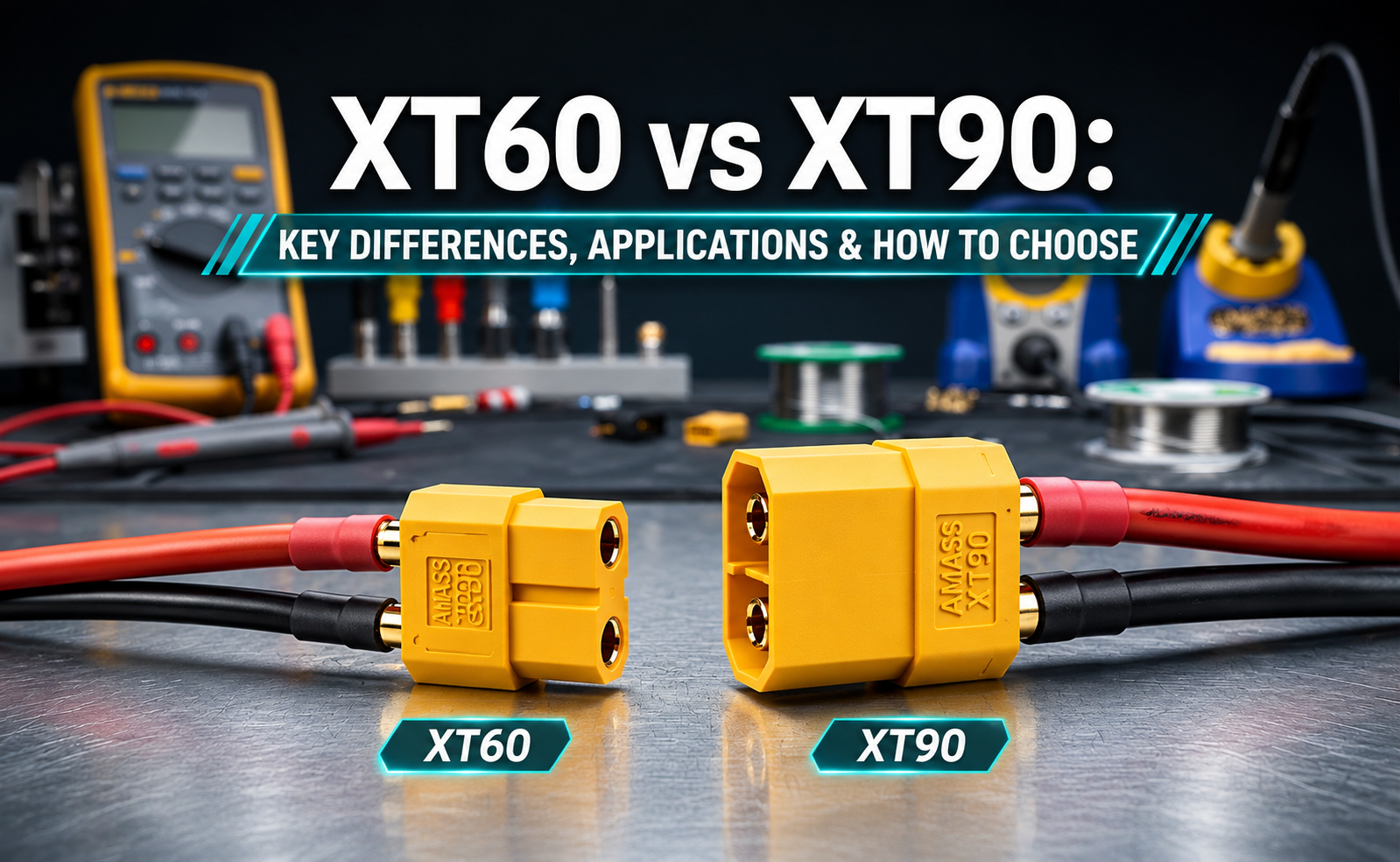
Two popular connectors in the RC and electronics industry are the XT60 and its larger counterpart, the XT90. Both feature polarized designs but are intended for different current requirements, wire sizes, and applications.
In this guide, we will explore the key differences between XT60 and XT90 connectors, their technical specifications, applications, and how to choose the right connector for your project.
1. XT60 vs XT90: Understanding the Key Differences
Although XT60 and XT90 connectors share a similar design, they differ in size, current-handling capability, weight, and electrical characteristics.
XT60 Connector Specifications
- Continuous Current Rating: Approximately 60A (manufacturer-dependent)
- Internal Pin Diameter: Approximately 3.5 mm
- Recommended Wire Gauge: 12–14 AWG
- Average Pair Weight: Approximately 7 grams
- Contact Resistance: Approximately 0.55 mΩ
XT90 Connector Specifications
- Continuous Current Rating: Approximately 90A (manufacturer-dependent)
- Internal Pin Diameter: Approximately 4.5 mm
- Recommended Wire Gauge: 8–10 AWG
- Average Pair Weight: Approximately 14 grams
- Contact Resistance: Approximately 0.30 mΩ
Actual current capacity depends on connector quality, wire gauge, soldering, temperature, and cooling conditions. Always verify the specifications of the particular connector being used.
2. Current Ratings and Electrical Performance
The primary difference between XT60 and XT90 connectors is their current-handling capability.
The XT60 is commonly selected for applications requiring moderate to high current delivery, with a nominal continuous rating of around 60A.
The XT90 is designed for higher-current applications, with a nominal continuous rating of around 90A.
The larger contact pins of the XT90 provide a greater contact area and can help reduce electrical resistance and heat generation when properly installed.
3. Physical Size and Internal Resistance
The XT90 is considerably larger and heavier than the XT60.
The XT60 uses approximately 3.5 mm bullet contacts, while the XT90 uses larger 4.5 mm contacts. The larger contact surface of the XT90 helps support higher-current applications.
However, the XT60 has an advantage in compact applications where weight and available installation space are important considerations.
4. What Is an XT90-S Anti-Spark Connector?
The XT90-S features anti-spark technology through a built-in pre-charge resistor.
When connecting a high-voltage battery to an electronic speed controller (ESC), sudden inrush current can create a visible spark at the connector contacts. Repeated electrical arcing can gradually damage the contact surfaces.
Key Benefits of XT90-S
- Helps reduce electrical sparking during connection.
- Limits initial inrush current.
- Helps protect connector contact surfaces.
- Supports safer battery connections in suitable applications.
5. Applications of XT60 Connectors
The XT60 is widely used in medium-power electronic and RC applications where a compact, lightweight connector is preferred.
- 5-inch to 7-inch FPV racing and freestyle drones.
- 3S to 6S LiPo battery connections.
- Medium-sized RC airplanes, gliders, and EDF jets.
- 1/10 scale RC cars, monster trucks, and rock crawlers.
- 3D printers and DIY power supply connections.
- Hobby electronics and battery-powered equipment.
6. Applications of XT90 Connectors
The XT90 is suitable for applications that require higher current-handling capacity and larger battery connections.
- Heavy-lift FPV drones and large multirotor systems.
- High-capacity 6S to 12S battery configurations.
- 1/8 and 1/5 scale RC cars.
- Electric skateboards and selected e-bike applications.
- High-power DIY battery systems.
- Heavy-duty combat robotics.
7. How to Choose Between XT60 and XT90 Connectors?
Step 1: Check Your Current Requirements
- Choose XT60 for applications within its verified current rating.
- Consider XT90 for applications requiring higher continuous current capacity.
- Never select a connector based only on its advertised peak current rating.
Step 2: Consider Battery Voltage
Both XT60 and XT90 connectors are used in different battery voltage configurations. For higher-voltage systems, consider an XT90-S where anti-spark protection is required.
Step 3: Check Wire Compatibility
- XT60: Commonly paired with 12–14 AWG wires.
- XT90: Commonly paired with 8–10 AWG wires.
Step 4: Consider Size and Weight
XT60 is suitable for compact applications where weight matters, while XT90 is useful for larger systems requiring higher current capacity.
8. Common Mistakes to Avoid When Selecting Battery Connectors
- Selecting a connector based only on peak current ratings.
- Using undersized wires for high-current applications.
- Ignoring connector temperature limits.
- Making poor solder joints.
- Using low-quality or counterfeit connectors.
- Ignoring battery voltage and polarity compatibility.
9. Conclusion: XT60 or XT90 – Which One Should You Choose?
Both XT60 and XT90 connectors play important roles in modern RC, FPV, and battery-powered electronics applications.
The XT60 remains a popular choice for everyday RC projects, medium-sized drones, and compact electronic systems because of its lightweight design and practical current capacity.
The XT90 is better suited to applications requiring higher current capacity, larger wire connections, and a more substantial connector design.
Ultimately, the right choice depends on your system's actual current requirements, wire specifications, operating conditions, and installation space.
About INFOCUS ELECTRONICS
INFOCUS ELECTRONICS supplies electronic connectors, LED lighting components, and electrical accessories for manufacturers, traders, and businesses across India.
Explore our website for more product information and business enquiries.
Website: www.infocuselectronics.com
Contact / WhatsApp: +91 93219 32158
INFOCUS ELECTRONICS – Your Trusted Partner for Electronic Components and Lighting Accessories.