How Does Lens Position Affect LED Light Output and Beam Shape?
LED lighting performance depends on more than wattage and brightness. The position of the optical lens relative to the LED light source also plays an important role in controlling how light travels, spreads and reaches the target surface.
Even a well-designed LED lens may not deliver the intended beam pattern if it is installed incorrectly. For street lights, flood lights, high bay lights and industrial luminaires, proper lens positioning helps achieve the desired light distribution and optical performance.
In this guide, we explain how LED lens positioning affects light output, beam angle, uniformity and the overall performance of LED lighting systems.
1. What Is the Role of an LED Lens?
An LED lens is an optical component designed to redirect light emitted by an LED into a desired distribution pattern. Depending on its optical design, a lens can concentrate light into a narrower beam, spread it over a wider area or create an asymmetric distribution for applications such as road lighting.
LED lenses are commonly used in:
- Street lights for controlled roadway illumination.
- Flood lights for outdoor areas and building exteriors.
- High bay lights for warehouses, factories and industrial facilities.
- Commercial luminaires that require specific beam distributions.
- Multi-LED modules that use individual lenses or lens arrays.
The lens works together with the LED package, mounting structure and luminaire housing. Its performance depends on the compatibility and alignment of the complete optical assembly.
2. How Does Lens Position Affect LED Light Output?
A. Lens Height Above the LED
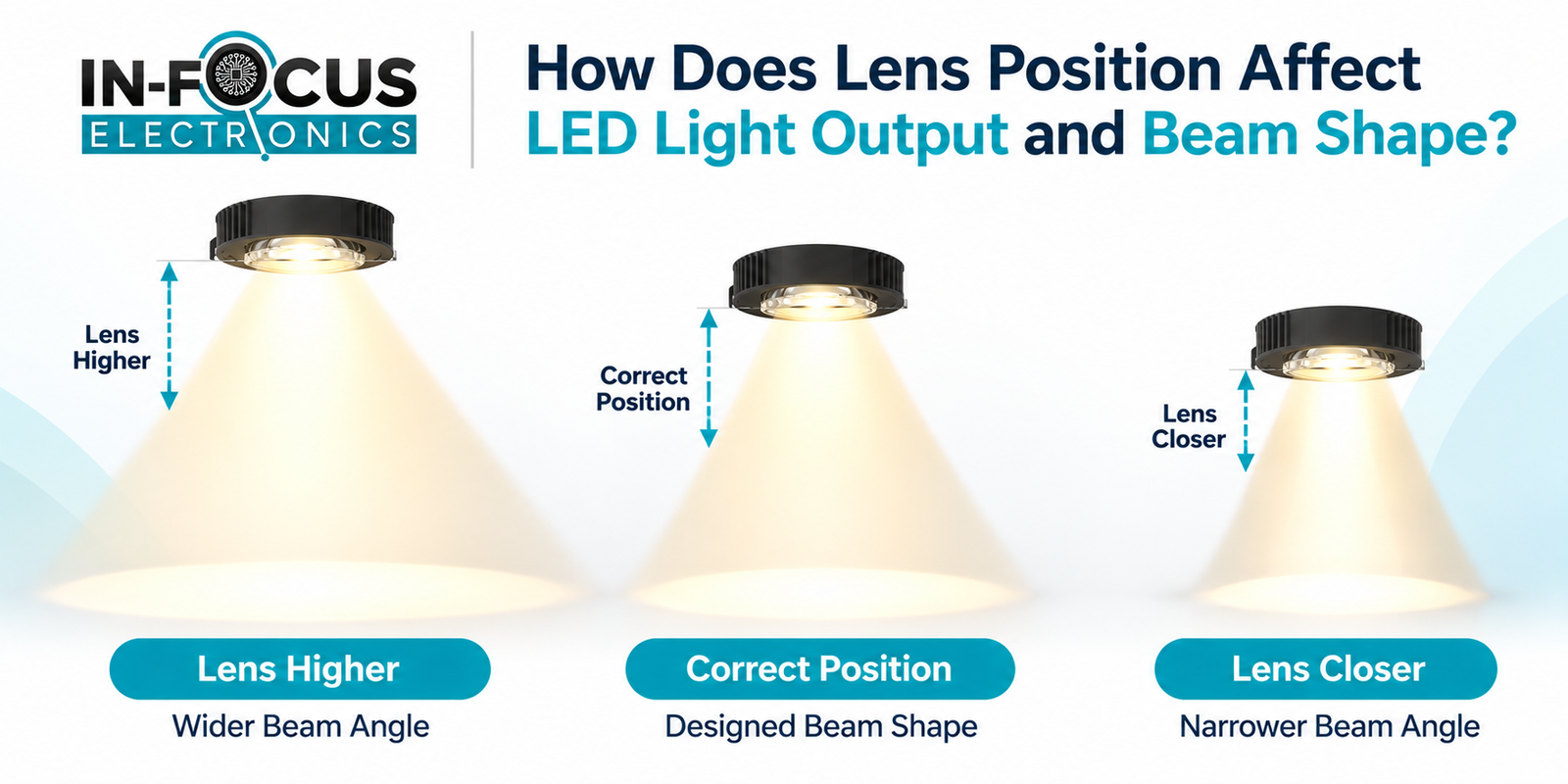
The distance between the LED emitting surface and the lens is an important optical design parameter. When a lens is installed at its specified height, it can redirect light according to the intended optical design.
If the lens is too close to or too far from the LED, the resulting beam pattern may differ from the intended distribution. Depending on the design, this can affect beam width, intensity distribution and the appearance of the illuminated area.
There is no universal ideal lens-to-LED distance. The correct spacing depends on the lens geometry, LED package, emitting area and optical design.
B. Horizontal Alignment
The LED must be positioned correctly beneath its corresponding lens or optical element. If the LED and lens are misaligned, the light distribution may become uneven or shift away from the intended direction.
In multi-lens arrays, alignment errors can also create inconsistencies between individual optical elements. Correct positioning is particularly important when several LEDs must produce a consistent lighting pattern.
C. Lens Orientation
Some lenses provide rotationally symmetric light distribution, while others create directional or asymmetric distributions. Installing a directional lens in the wrong orientation can direct light away from the intended target.
For example, an asymmetric street light lens must be oriented according to its optical design and roadway lighting requirements.
3. How Lens Position Influences Beam Angle
Beam angle describes the angular spread of light from an optical system under a specified measurement convention. The lens design determines the intended distribution, while installation position and alignment can affect the resulting beam pattern.
Narrow Beam Distribution
Narrow-beam optics concentrate light into a relatively limited angular region. They can be useful for selected high bay, spotlighting and long-distance illumination applications. Incorrect positioning may change the intended concentration and distribution of light.
Wide Beam Distribution
Wide-beam optics distribute light across a broader angular region and can be suitable for applications requiring extensive coverage. The lens must be installed at the specified height and orientation to achieve the intended distribution.
Asymmetric Beam Distribution
Asymmetric optics direct light differently across two axes. They are commonly used in street lighting and other applications where light needs to be distributed preferentially in a particular direction.
The actual beam angle and light distribution should be verified using manufacturer specifications or photometric measurements rather than estimated from lens position alone.
4. What Happens When an LED Lens Is Installed Incorrectly?
- Uneven illumination: Misalignment between the LED and lens can create an inconsistent distribution across the target area.
- Unexpected beam spread: Incorrect spacing or orientation may cause the beam pattern to differ from the intended design.
- Reduced useful illumination: Light may be directed outside the required area even when the LED produces adequate luminous flux.
- Glare and unwanted spill light: Incorrectly oriented optics can direct light towards unwanted locations or viewing angles.
- Inconsistent lens-array performance: Positioning errors across multiple LEDs can create differences in light distribution.
These problems do not necessarily mean the lens material is defective. Possible causes include incorrect mounting, incompatible components, manufacturing tolerances or a mismatch between the lens and LED package.
5. How to Ensure Correct LED Lens Positioning
Step 1: Verify LED and Lens Compatibility
Check that the lens is designed for the LED package being used. Package dimensions, emitting area and optical design all influence compatibility. For multi-LED arrays, confirm the intended LED configuration and module footprint before assembly.
Step 2: Follow the Specified Mounting Dimensions
Use the manufacturer's recommended lens height, mounting points and mechanical tolerances. Do not assume that two lenses with similar external dimensions require identical mounting heights.
Step 3: Check Alignment Before Final Assembly
Confirm that each LED is centred correctly beneath its intended optical element and that the lens array is seated securely. Check for tilted lenses, displaced modules and mechanical interference.
Step 4: Verify Lens Orientation
For asymmetric or directional optics, follow the orientation marks and installation instructions. Ensure that the optical distribution matches the intended lighting layout.
Step 5: Test the Completed Luminaire
Evaluate the assembled product for light distribution, beam shape and uniformity. For applications requiring precise photometric performance, use suitable optical testing equipment or photometric reports.
Testing the complete luminaire is important because the LED, lens, reflector, diffuser and housing can all influence the final result.
6. Why Lens Position Matters in Different LED Lighting Applications
Street Lighting
Street lights require controlled light distribution across roadways and surrounding areas. Correct positioning and orientation of the optical lens help achieve the intended roadway distribution and manage unwanted spill light.
LED Flood Lights
Flood lights illuminate building facades, outdoor work areas, parking areas and other large spaces. Proper lens alignment helps direct light towards the target and maintain the intended beam pattern.
High Bay Lighting
High bay luminaires are commonly installed in warehouses, factories and other high-ceiling environments. Lens selection and placement influence how light reaches the floor and working surfaces.
Multi-LED Lighting Modules
Modules containing multiple LEDs require consistent alignment between the LED packages and optical array. Small variations in positioning can create differences in the resulting light distribution.
7. How to Select the Right LED Lens for Your Lighting Project
Choosing an LED lens involves more than matching its external dimensions. Lighting manufacturers and OEM buyers should consider the following factors:
- LED package compatibility: Confirm that the lens is designed for the selected LED package and emitting area.
- Beam angle: Select a distribution that suits the application and required illumination pattern.
- Module footprint: Verify the lens dimensions and mounting arrangement against the LED module.
- Optical material: Consider the material's optical properties, temperature suitability and environmental requirements.
- Mounting position: Follow the specified spacing, alignment and orientation.
- Photometric performance: Review available test data to verify the intended light distribution.
For product options and optical component details, explore the LED Lens and Optical Components range from INFOCUS ELECTRONICS.
8. Why Choose the Right Optical Components?
Selecting compatible optical components helps lighting manufacturers achieve the required beam distribution and maintain consistency across production batches. Correct lens positioning, suitable LED compatibility and proper assembly practices all contribute to the intended optical performance of the finished luminaire.
Whether you are developing street lights, flood lights or high bay luminaires, evaluate the complete optical assembly rather than selecting a lens by appearance or dimensions alone.
Conclusion
Lens position is an important factor in LED optical performance. Lens height, horizontal alignment and orientation can influence the resulting beam pattern, light distribution and uniformity. Following the manufacturer's mounting specifications and testing the completed luminaire helps ensure that the optical system performs as intended.
INFOCUS ELECTRONICS supplies LED optical lens solutions for lighting applications. Explore our LED lens product category to learn more about available optical components for your lighting requirements.