How to Choose an LED Flood Light Lens for Beam Control and Uniformity
Introduction
LED flood lights are widely used in warehouses, industrial facilities, parking areas, sports grounds, building facades, and outdoor lighting installations. However, achieving effective illumination depends on more than the brightness of the LED. The optical lens also plays an important role in controlling the direction, spread, and distribution of light.
An LED flood light lens helps direct light toward the required area, improving lighting control and helping achieve more uniform illumination. Choosing the correct lens can help reduce unwanted light spill, minimize bright and dark spots, and improve the overall performance of an LED lighting system.
For LED lighting manufacturers, OEMs, and lighting designers, understanding beam angles, optical materials, and application requirements is essential when selecting a suitable LED flood light lens.
What Is an LED Flood Light Lens?
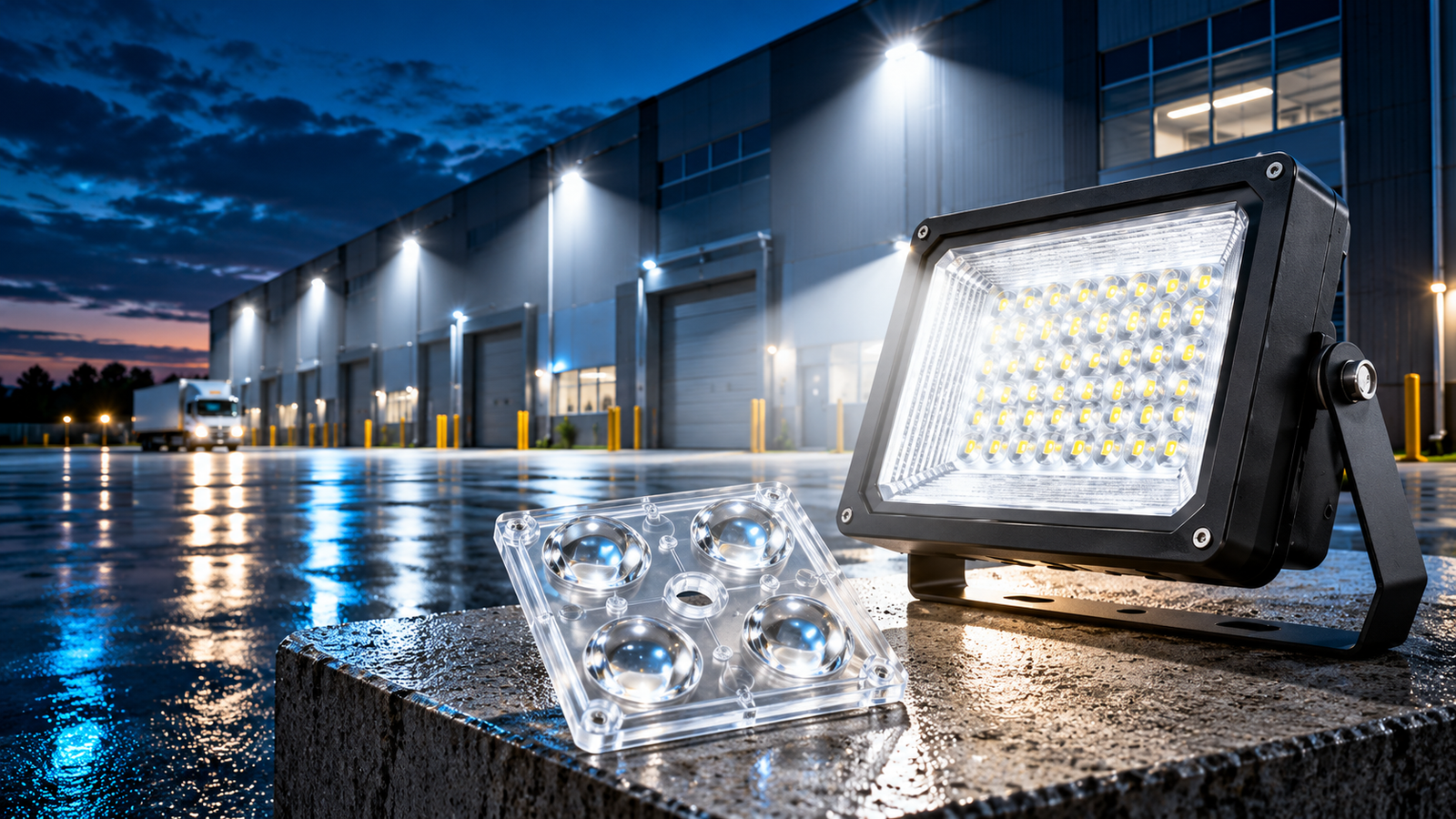
An LED flood light lens is an optical component designed to control how light travels from an LED source. Depending on its optical design, it can distribute light across a wide area or concentrate it toward a specific target.
These lenses are commonly manufactured using optical-grade polycarbonate (PC) or polymethyl methacrylate (PMMA). The appropriate material depends on factors such as light transmission, operating temperature, impact resistance, and environmental conditions.
LED flood light lenses are available in different configurations and beam distributions to meet the requirements of various lighting applications.
1. Understand the Required Beam Angle
Beam angle is one of the most important factors when choosing an LED flood light lens. It describes how widely light spreads from the lighting fixture.
A narrow beam concentrates light into a smaller area, while a wider beam distributes light across a larger surface.
Common beam distributions include:
- Narrow beam for focused illumination and distant targets.
- Medium beam for balanced coverage in industrial and commercial applications.
- Wide beam for larger areas, open yards, and building exteriors.
- Asymmetric beam for directing light in a particular direction, such as across a roadway or elongated target area.
The appropriate beam angle depends on mounting height, target distance, area dimensions, fixture spacing, and required illuminance.
Always review the lens photometric data rather than selecting a lens based on its beam angle alone.
2. Select a Lens According to the Application
Different applications require different light distributions.
Industrial and Warehouse Lighting
Industrial facilities and warehouses require suitable illumination across workstations, storage areas, and loading zones. The lens should distribute light according to the fixture mounting height and layout while limiting excessive glare and dark areas.
Outdoor Area Lighting
Parking lots, industrial yards, and open spaces often require wide-area illumination. A suitable optical lens can help distribute light across the target area and reduce unnecessary light spill.
Building Facade Lighting
Architectural flood lighting is used to illuminate walls, signs, structures, and building features. A controlled beam distribution helps direct light toward the intended surface and achieve the desired lighting effect.
Sports Grounds and High-Mast Lighting
Sports facilities and high-mast installations require careful control of light distribution across large areas. Lens selection should consider mounting height, aiming direction, uniformity, and glare control.
3. Consider Light Uniformity
Light uniformity describes how evenly illumination is distributed across a surface. Poor uniformity can create bright patches, dark zones, and uncomfortable visual conditions.
The right LED flood light lens helps shape light distribution to suit the application. However, uniformity also depends on fixture positioning, mounting height, spacing, output, and aiming.
When evaluating a lens, consider:
- Beam distribution across the target area.
- Overlap between adjacent light beams.
- Fixture mounting height and spacing.
- Photometric data and lighting simulation results.
- Glare and unwanted light spill.
A well-designed optical system balances coverage and light intensity instead of simply maximizing brightness at the centre.
4. Choose the Right Optical Material
The material of an LED flood light lens affects optical transmission, durability, and long-term performance.
Polycarbonate (PC)
Optical-grade polycarbonate is commonly used when impact resistance and durability are important. Its suitability depends on the material grade, operating temperature, UV exposure, and installation conditions.
PMMA (Acrylic)
Optical-grade PMMA is often selected for applications requiring good light transmission and optical clarity. The chosen grade should be suitable for the expected temperature and environmental exposure.
When comparing lens materials, consider optical transmission, resistance to yellowing, temperature limits, dimensional stability, and compatibility with the lighting fixture.
5. Check LED Compatibility and Lens Configuration
An LED flood light lens must be compatible with the LED package and the mechanical arrangement of the fixture.
Before choosing a lens, verify the following:
- LED compatibility: Confirm whether the lens is designed for LED packages such as 3030 or 3535, where applicable.
- Lens configuration: Check whether the lens is a single-lens design or a multi-position array.
- Dimensions: Verify the lens size, pocket arrangement, mounting points, and PCB alignment.
- Optical alignment: Ensure that each LED is correctly positioned relative to the lens.
- Thermal design: Confirm that the complete luminaire has suitable heat management.
Correct compatibility helps maintain consistent optical performance and simplifies assembly during production.
6. Evaluate Optical Efficiency
Not all light emitted by an LED reaches the intended target. Some light may be absorbed, reflected, or directed outside the useful illumination zone.
When evaluating an LED flood light lens, review its optical transmission specifications, material quality, surface finish, and photometric performance.
Remember that optical transmission alone does not determine the efficiency of the complete lighting fixture. LED performance, lens design, protective covers, reflectors, and housing geometry also affect the final result.
The objective is to deliver useful light where it is required while minimizing unnecessary light loss and spill.
7. Consider Environmental Conditions
LED flood lights are often installed outdoors or in demanding industrial environments. The lens should be suitable for the intended operating conditions.
Consider these factors:
- Temperature: Check the material's recommended operating limits.
- UV exposure: Select an appropriate material grade for outdoor installations.
- Dust and moisture: Ensure that the complete luminaire has the required IP rating.
- Impact resistance: Consider the risk of mechanical damage during installation or operation.
- Maintenance: Choose a lens that can be cleaned without damaging its optical surface.
An IP rating applies to the properly assembled enclosure or luminaire and should not automatically be assumed for the lens alone.
8. Test the Lens Before Mass Production
For lighting manufacturers and OEMs, testing a sample lens under representative conditions helps verify that it meets the project requirements.
Follow these steps:
- Confirm the LED package and lens dimensions.
- Review the manufacturer's beam-angle and photometric information.
- Simulate the lighting layout using the intended mounting height and fixture spacing.
- Assemble a sample luminaire and measure its light distribution.
- Evaluate illuminance uniformity, glare, and unwanted light spill.
- Verify performance under the expected operating conditions.
Photometric testing can help manufacturers identify optical problems before proceeding with mass production.
Common Mistakes to Avoid
Avoid these common mistakes when selecting an LED flood light lens:
- Choosing a beam angle without considering mounting height.
- Assuming that a wider beam always produces better uniformity.
- Ignoring LED package compatibility.
- Overlooking lens alignment and fixture spacing.
- Comparing lenses using optical transmission figures alone.
- Ignoring temperature and UV exposure.
- Finalizing a design without reviewing photometric data or testing a sample.
The best lens is one that meets the application's optical, mechanical, and environmental requirements as part of the complete lighting system.
Conclusion
Choosing the right LED flood light lens requires careful consideration of beam angle, light uniformity, optical material, LED compatibility, and installation conditions.
A properly selected and tested lens can help deliver controlled illumination, reduce unwanted light spill, and achieve a suitable balance between coverage and light intensity.
INFOCUS ELECTRONICS supplies LED optical lenses and lighting components for manufacturers, OEMs, and lighting businesses. Selecting the right optical solution for the intended application helps lighting manufacturers develop reliable and effective LED flood light systems.
Frequently Asked Questions
Which beam angle is best for an LED flood light?
There is no single best beam angle for every application. The correct choice depends on the target area, mounting height, fixture spacing, required illuminance, and desired light distribution.
How does an LED flood light lens improve uniformity?
A lens shapes the distribution of light emitted by the LED. When correctly matched to the lighting layout, it can help reduce excessively bright areas and dark zones. Final uniformity also depends on fixture positioning and aiming.
Which materials are used for LED flood light lenses?
Optical-grade polycarbonate (PC) and PMMA (acrylic) are commonly used. The suitable material depends on optical requirements, temperature, UV exposure, and environmental conditions.
Are LED flood light lenses compatible with every LED?
No. Compatibility depends on the LED package, lens geometry, optical alignment, and mounting arrangement. Always verify the manufacturer's specifications before assembly.
How can I check an LED flood light lens's performance?
Review the manufacturer's photometric data, beam distribution, and material specifications. For important projects, test a sample luminaire or use lighting simulation to evaluate its performance.
Can one LED lens be used for every flood light application?
Not always. Different applications may require different beam patterns and optical configurations. Lens selection should be based on the specific lighting requirements.