How to Choose the Right LED Lens for Street Lights, Flood Lights & High Bay Lights
Choosing the right LED optical lens can have a significant impact on the performance, coverage, and light distribution of a street light, flood light, high bay light, or industrial LED fixture.
The LED generates the light, but the optical lens controls how that light is distributed. A properly selected lens can help achieve controlled beam patterns, better illumination uniformity, improved coverage, and more effective use of LED output.
Choosing an unsuitable lens can result in uneven illumination, excessive glare, unwanted light spill, poor coverage, or inefficient optical performance.
Whether you are an OEM, LED lighting manufacturer, electrical contractor, lighting distributor, or procurement professional, understanding beam angle, LED package compatibility, mounting height, optical material, and luminaire design can help you select the right LED lens for your application.
What Is an LED Optical Lens?
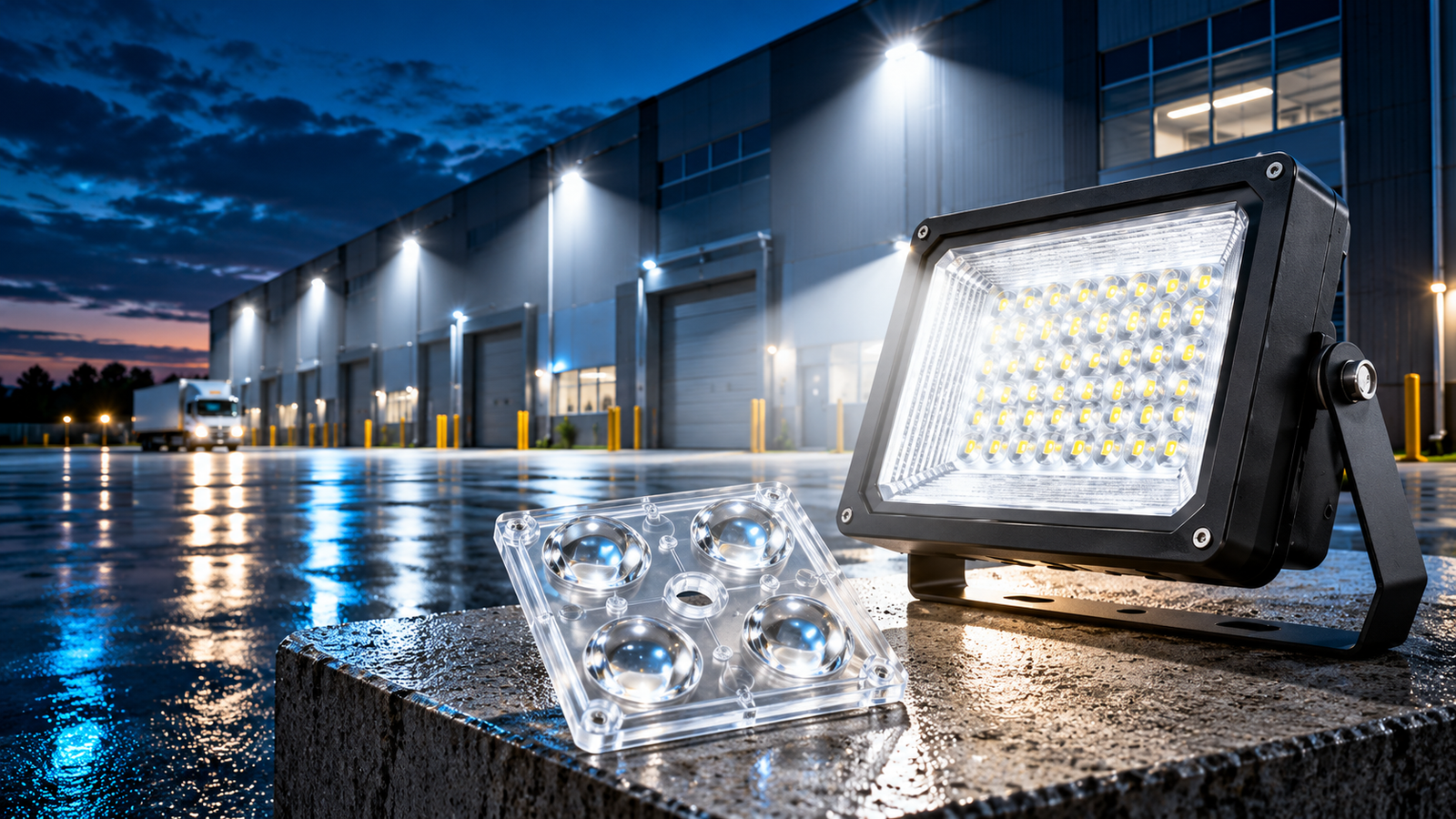
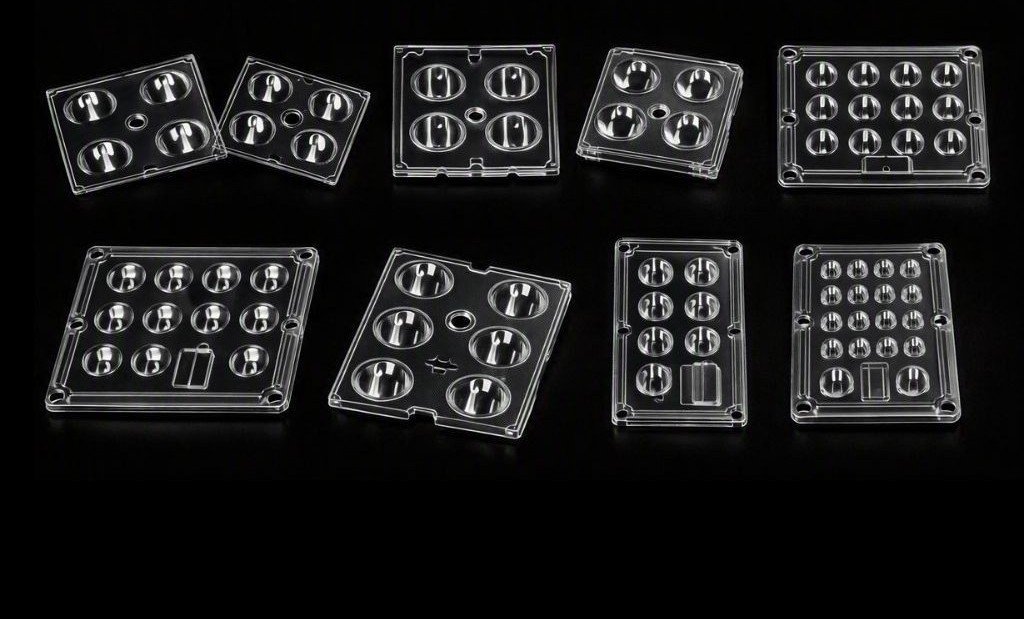
An LED optical lens is a precision optical component designed to control, shape, and direct the light produced by an LED.
Instead of allowing LED light to spread in an uncontrolled manner, the lens helps create a specific beam pattern suitable for the intended lighting application.
LED optical lenses are commonly used in:
- Street lights
- Flood lights
- High bay lights
- Industrial lighting
- Warehouse lighting
- Outdoor LED lighting
- Commercial lighting
- Architectural lighting
- Area lighting
- Roadway luminaires
The optical lens can influence the beam angle, light distribution, coverage area, and illumination uniformity of the complete LED lighting fixture.
For this reason, lens selection should be considered as an important part of the overall optical design rather than simply as a mechanical component.
Why Is an LED Lens Important?
An LED produces light, but the optical lens helps determine where that light goes and how it is distributed.
A suitable LED optical lens can help provide:
- Controlled light distribution
- Defined beam angle
- Better illumination uniformity
- Reduced unwanted light spill
- Improved coverage
- Better glare control
- Effective use of LED output
- Application-specific light patterns
- Consistent optical performance
For OEMs and lighting manufacturers, selecting the correct optical lens can therefore be an important part of luminaire development.
The LED, optical lens, reflector or housing, and overall luminaire design should work together to achieve the required lighting performance.
Understanding LED Lens Beam Angles
Beam angle is one of the most important specifications when selecting an LED optical lens.
It describes how widely the light is distributed from the optical system. A narrower beam generally concentrates light into a smaller area, while a wider beam distributes light across a larger area.
However, beam angle should not be selected in isolation. Mounting height, LED output, illuminated area, installation geometry, and the desired lighting pattern should also be considered.
Narrow Beam LED Lens
A narrow beam lens concentrates light into a relatively smaller area.
This type of optical distribution can be useful when light needs to travel farther or when concentrated illumination is required.
Typical applications
- High mounting positions
- Long-distance illumination
- Selected roadway areas
- High bay lighting
- Focused outdoor lighting
For example, a 15-degree LED lens produces a considerably more concentrated distribution than a wider-angle lens.
Narrow beam optics can be particularly useful where controlled projection is required, but the final result should always be evaluated according to the actual luminaire and installation conditions.
Medium Beam LED Lens
A medium beam lens provides a balance between concentrated illumination and wider coverage.
It may be suitable for applications where neither a highly concentrated beam nor extremely wide distribution is required.
Typical applications
- Industrial lighting
- Commercial areas
- Warehouse lighting
- Medium-height installations
- General outdoor lighting
Medium beam optics can provide a practical balance between coverage and concentration depending on the fixture design.
Wide Beam LED Lens
A wide beam lens distributes light across a larger area.
Wide beam optics can be useful when broad coverage is more important than long-distance projection.
Typical applications
- Flood lighting
- Large outdoor areas
- Parking areas
- Open industrial spaces
- Warehouses
- Area lighting
- Low and medium mounting heights
The correct beam angle should always be selected according to the mounting height, illuminated area, LED output, required coverage, and desired light distribution.
Narrow vs Medium vs Wide Beam: Which Is Right?
Instead of using a traditional table, consider the application requirements:
Choose a Narrow Beam When:
You need more concentrated illumination, longer-distance projection, or controlled light distribution from a higher mounting position.
Common applications: high bay lighting, focused outdoor lighting, long-distance illumination.
Choose a Medium Beam When:
You need a balance between coverage and concentration.
Common applications: industrial facilities, warehouses, commercial areas, and medium-height installations.
Choose a Wide Beam When:
You need broad coverage across a relatively large area.
Common applications: flood lights, parking areas, warehouses, open industrial spaces, and area lighting.
Important: The "best" beam angle depends on the complete lighting design. A beam angle that works well for one fixture may not provide the same result in another fixture.
How to Choose an LED Lens for Street Lights
Street lighting requires controlled and reasonably uniform illumination across roads and surrounding areas.
The correct street light lens can help direct light toward the required area while reducing unnecessary light spill.
1. Consider the Required Light Distribution
First determine how the light needs to be distributed across the road.
The optical pattern should provide appropriate coverage while supporting the required illumination uniformity.
Roadway lighting may require a different optical distribution from a general flood light because the illuminated area has a specific geometry.
2. Consider Mounting Height
Mounting height has a direct influence on optical requirements.
Higher installations may require more controlled optical distribution, while lower mounting positions may allow wider distributions depending on the application.
3. Consider Road Width
Road width and the required coverage area should be considered when selecting a street light lens.
The optical distribution should work with the road geometry, pole position, mounting angle, and luminaire location.
4. Check LED Package Compatibility
Always verify that the lens is designed for the LED package being used.
Common LED packages include:
- 3030
- 3535
- 5050
The LED package and optical lens should be properly aligned to achieve the intended optical performance.
5. Evaluate Optical Performance
Do not select a street light lens based only on its physical dimensions.
Also evaluate:
- Optical efficiency
- Light transmission
- Beam consistency
- Illumination uniformity
- Glare control
- Lens-to-LED alignment
- Optical distribution
Choosing an LED Lens for Flood Lights
LED flood lights are used for a wide variety of outdoor, commercial, industrial, and security lighting applications.
Common applications include:
- Outdoor areas
- Industrial facilities
- Warehouses
- Building illumination
- Parking areas
- Security lighting
- Commercial properties
- Large open spaces
When selecting an LED flood light lens, consider:
- Required coverage area
- Mounting height
- Distance to the illuminated area
- Beam angle
- LED package
- Light distribution
- Illumination uniformity
- Glare
- Lens dimensions
- Luminaire design
A wide beam may be suitable when broad coverage is required over a relatively short distance.
A narrow beam may be more appropriate when light needs to travel farther or be concentrated into a particular area.
The final selection should be verified through optical testing or photometric evaluation where required.
Choosing an LED Lens for High Bay Lights
High bay lighting is commonly used in:
- Warehouses
- Factories
- Production facilities
- Workshops
- Industrial buildings
- Manufacturing facilities
- Large commercial spaces
Because high bay fixtures are often installed at significant ceiling heights, optical distribution must be carefully considered.
When selecting a high bay LED lens, consider:
- Ceiling height
- Mounting position
- Floor illumination requirements
- Beam angle
- LED power
- Required coverage
- Lighting layout
- Desired light distribution
- Illumination uniformity
A suitable high bay lens can help direct available LED light toward the working area and reduce unnecessary light distribution.
The correct optical pattern can also help manufacturers design fixtures according to the requirements of the installation.
Match the LED Lens With the LED Package
One of the most important considerations when choosing an LED optical lens is LED package compatibility.
Common LED packages include:
- 3030 LEDs
- 3535 LEDs
- 5050 LEDs
3030 LED Lens
3030 LED lenses are designed for compatible 3030 LED packages and are used in various outdoor, industrial, commercial, and general lighting applications.
3535 LED Lens
3535 LED lenses are designed for compatible 3535 LED packages and can be used in professional lighting fixtures requiring controlled optical performance.
5050 LED Lens
5050 LED lenses are designed for compatible 5050 LED packages and can be used in applications requiring suitable beam control and light distribution.
Before purchasing an LED optical lens, confirm:
- LED package type
- LED dimensions
- LED footprint
- LED position
- Lens mounting method
- Optical alignment
- Required beam pattern
- Luminaire compatibility
A lens that physically fits a fixture does not automatically guarantee the required optical performance.
Why Optical Lens Material Matters
The material used to manufacture an LED optical lens can influence its optical clarity, light transmission, mechanical durability, temperature resistance, and long-term performance.
Optical-grade polycarbonate (PC) is commonly used for LED optical lenses because it can provide a combination of optical clarity and mechanical durability.
When evaluating an optical lens material, consider:
- Optical clarity
- Light transmission
- Operating temperature
- Mechanical durability
- UV exposure
- Outdoor environmental conditions
- Long-term operating requirements
For professional lighting applications, material selection should be based on the fixture design, operating temperature, environmental conditions, and expected service requirements.
Common Mistakes When Selecting an LED Optical Lens
Choosing an LED lens only by its size or price can result in poor lighting performance.
Here are some common mistakes to avoid.
Choosing Only by Size
A lens may physically fit inside a luminaire but still produce an unsuitable beam pattern.
Physical compatibility and optical compatibility are two different considerations.
Ignoring Beam Angle
Beam angle should be selected according to mounting height, coverage requirements, target area, and desired illumination.
Not Checking LED Compatibility
The lens should be properly matched with the LED package and optical position.
Incorrect positioning can affect the intended beam pattern and optical performance.
Using the Same Lens for Every Application
Street lights, flood lights, and high bay lights have different optical requirements.
A lens designed for one application may not provide the desired performance in another.
Ignoring Installation Height
The same beam angle can produce significantly different coverage depending on mounting height.
For this reason, beam angle should always be evaluated together with installation height.
Focusing Only on Price
A low-cost lens may not provide the optical consistency, durability, or performance required for a professional lighting project.
For OEM applications, it is generally better to evaluate total optical performance, consistency, compatibility, and supply reliability rather than price alone.
What Should OEMs Look for in an LED Lens Supplier?
For OEMs and lighting manufacturers, choosing the right supplier can be just as important as selecting the right optical lens.
A suitable LED lens supplier should ideally provide:
- Consistent optical quality
- Multiple beam angle options
- LED package compatibility
- Accurate technical specifications
- Product samples
- Bulk supply capability
- Ready stock
- Competitive pricing
- Fast delivery
- Technical assistance
For production applications, consistent dimensions and optical performance are particularly important because variations between batches can affect the final lighting product.
A reliable LED optical lens supplier can also help manufacturers evaluate suitable products before committing to large quantities.
LED Optical Lenses for Professional Lighting Applications
IN-Focus Electronics supplies LED optical lenses for professional lighting applications, including:
- Street lighting
- Flood lighting
- High bay lighting
- Industrial lighting
- Outdoor lighting
- Commercial lighting
- Area lighting
The company focuses on supplying quality products with ready stock, competitive pricing, bulk supply, and fast delivery for OEMs, lighting manufacturers, traders, and businesses across India.
Samples are also available for project evaluation and testing.
If you are developing or sourcing LED lighting products, you can explore the available LED optical lens range to compare suitable options.
How to Select the Right LED Lens: Quick Checklist
Before placing an order, review these points:
1. What is the lighting application?
Street light, flood light, high bay, industrial, commercial, or another application?
2. What beam angle is required?
Determine whether narrow, medium, wide, or another optical distribution is appropriate.
3. What is the mounting height?
The installation height affects the required light distribution and coverage.
4. What area needs to be illuminated?
Consider road width, floor area, outdoor space, working area, or target surface.
5. Which LED package is being used?
Confirm whether the fixture uses 3030, 3535, 5050, or another LED package.
6. Is the lens physically compatible?
Check dimensions, mounting arrangement, LED position, and fixture design.
7. Is the optical alignment correct?
The LED and lens should be correctly positioned relative to each other.
8. What optical material is being used?
Consider optical clarity, temperature resistance, durability, and environmental conditions.
9. Is the required quantity available?
For OEM production, supply consistency and stock availability are important considerations.
10. Can samples be tested before bulk purchasing?
Testing samples can help verify optical performance, physical compatibility, beam angle, and overall fixture performance.
Frequently Asked Questions About LED Optical Lenses
What does an LED optical lens do?
An LED optical lens controls and directs the light produced by an LED to create a specific beam distribution and light pattern.
Which LED lens is suitable for street lights?
The suitable street light lens depends on factors such as road width, mounting height, LED package, luminaire position, required coverage, and desired light distribution.
What beam angle is best for LED flood lights?
There is no single beam angle that is best for every flood light.
Wide beam lenses can be useful for broad coverage, while narrower beams can be useful for longer-distance or more concentrated illumination.
Which lens is used for high bay lights?
High bay lenses are selected according to ceiling height, LED package, mounting position, required coverage, fixture design, and desired light distribution.
Are LED lenses compatible with 3030, 3535, and 5050 LEDs?
LED optical lenses are available for different LED packages, including 3030, 3535, and 5050.
However, compatibility should always be confirmed based on the specific LED model, dimensions, optical position, and lens design.
What material is commonly used for LED optical lenses?
Optical-grade polycarbonate is commonly used for LED optical lenses because it can offer a combination of optical clarity and mechanical durability.
Can I get LED optical lens samples before bulk purchasing?
Samples can be useful for checking optical performance, LED compatibility, beam angle, physical fit, and overall luminaire performance before placing a bulk order.
How do I choose between a narrow and wide LED lens?
Consider the mounting height, required coverage, distance to the target area, LED output, and desired light distribution.
Narrow beams generally provide more concentrated illumination, while wide beams generally provide broader coverage.
Final Thoughts
Choosing the right LED optical lens is an important part of developing an efficient and reliable LED lighting fixture.
The correct selection should consider:
- Lighting application
- Beam angle
- Mounting height
- Required light distribution
- LED package
- Lens dimensions
- Optical alignment
- Optical material
- Luminaire design
- Environmental conditions
- Required illumination uniformity
Whether you are developing a street light, flood light, high bay light, industrial luminaire, warehouse fixture, or outdoor LED lighting system, selecting the correct optical lens can help improve the final lighting performance.
The key is to select the lens based on the complete lighting requirement, rather than choosing a product only by physical size or price.
Need the Right LED Optical Lens for Your Project?
Looking for the right LED optical lens for your lighting project?
IN-Focus Electronics can help you identify suitable LED lens options based on your LED package, application, beam angle, luminaire design, and project requirements.
Contact our team for:
- Product specifications
- LED lens samples
- Beam angle options
- Bulk supply
- OEM requirements
- Competitive pricing
Whether you need a small quantity for testing or bulk quantities for OEM production, selecting the right optical lens at the beginning of your project can help you develop a more effective and reliable LED lighting solution.
Explore our LED optical lens range to find suitable options for your lighting application.