LED Lens vs Reflector: Which Is Better for LED Lighting?
When designing an LED lighting fixture, one important decision is how to control and distribute the light produced by the LED. Two commonly used optical solutions are LED lenses and reflectors.
Both are designed to control light distribution, but they work in different ways and can produce different optical results. The right choice depends on the LED type, fixture design, beam angle, application and required light distribution.
In this guide, we explain the difference between LED lenses and reflectors, their applications, advantages and the factors to consider when selecting an optical solution.
What Is an LED Lens?
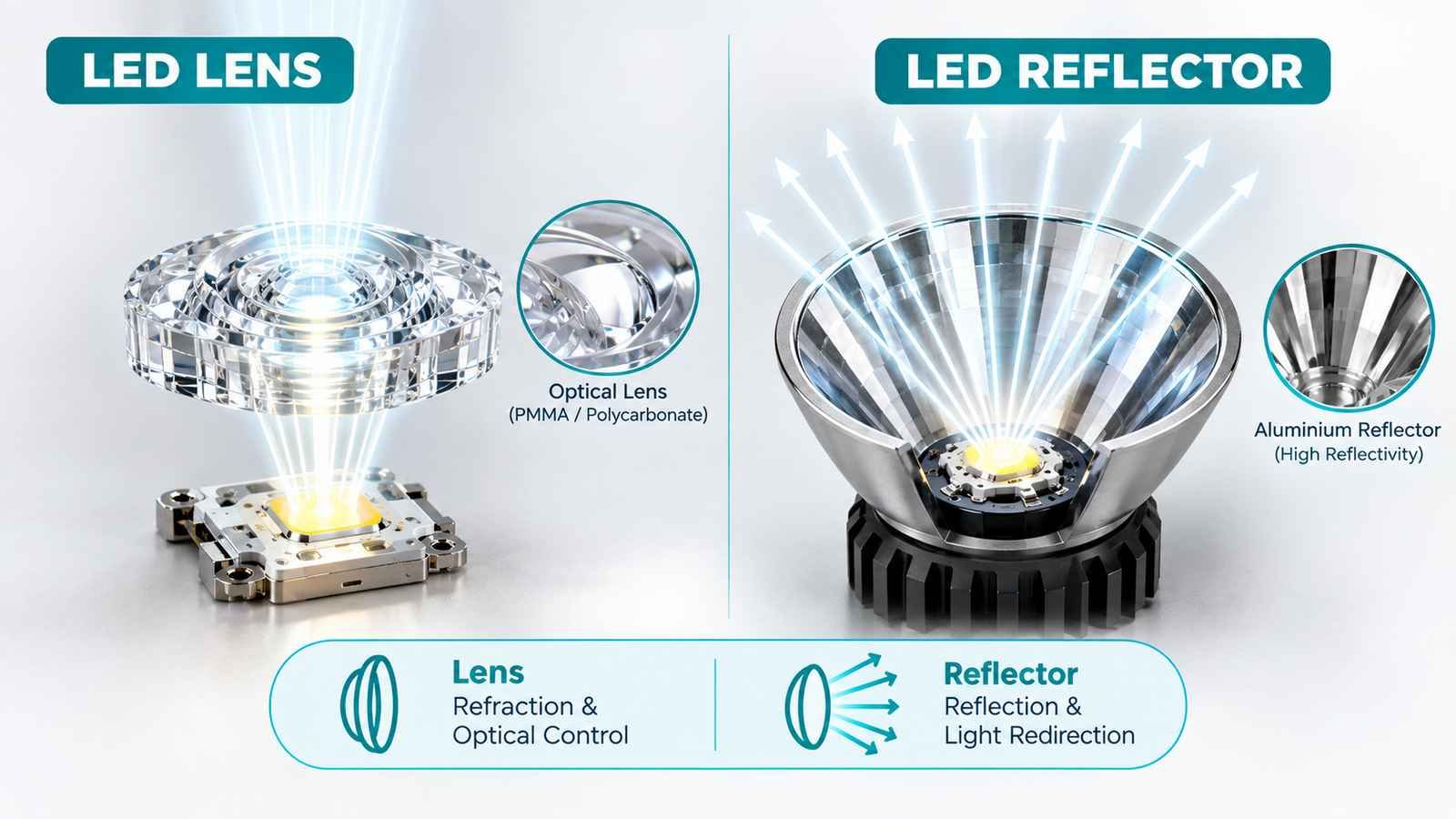
An LED lens is an optical component designed to control, redirect and distribute light produced by an LED.
LED lenses use optical geometry to shape the light into a specific beam pattern. Depending on the design, a lens can create narrow, medium, wide or application-specific light distributions.
LED lenses are commonly used in:
- Street lights
- Flood lights
- High bay lights
- Industrial lighting
- Commercial lighting
- Outdoor lighting
- Architectural lighting
- LED modules
Different lens designs are available for different LED packages and lighting requirements.
What Is an LED Reflector?
An LED reflector is an optical component that uses a reflective surface to redirect light from an LED.
Reflectors are generally designed with a curved or angled internal surface. Light emitted from the LED reaches the reflector and is redirected toward the required area.
Reflectors can be found in flood lights, downlights, spotlights, high-power LED fixtures and other lighting products.
How Does an LED Lens Work?
An LED lens works primarily through the optical properties and geometry of the lens material.
The lens receives light from the LED and changes its direction according to the optical design.
The shape of the lens determines the resulting beam pattern.
For example:
LED → Optical Lens → Controlled Light Distribution
The lens can be designed to produce specific optical distributions for different applications.
How Does an LED Reflector Work?
A reflector redirects LED light using a reflective surface.
The basic principle is:
LED → Reflective Surface → Redirected Light
The shape and reflective properties of the reflector influence the resulting beam pattern.
Reflectors are available in different shapes and sizes depending on the required optical performance and fixture design.
LED Lens vs Reflector: Key Differences
The main difference is how the optical component controls the light.
An LED lens uses refraction and optical geometry, while a reflector primarily uses reflection.
A lens can be specifically designed to produce a particular beam distribution and may be particularly useful when precise optical control is required.
A reflector can provide an effective solution where the fixture design and application are suited to reflective optics.
Beam Angle
Beam angle is an important factor when comparing lenses and reflectors.
LED lenses can be designed for different beam angles and distributions, including narrow, medium and wide patterns.
Reflectors can also produce different beam distributions depending on their shape and geometry.
The correct beam angle should be selected based on the application rather than choosing an optical component simply because it is a lens or reflector.
LED Lens for Street Lighting
Street lighting requires controlled light distribution across roads and surrounding areas.
Specialized street light lenses can be designed to produce specific distributions, including asymmetric patterns.
This allows the optical system to direct light where it is required instead of distributing the light equally in every direction.
For street lighting, factors such as road width, pole height, LED position and required illumination pattern should be considered.
LED Lens for Flood Lighting
Flood lights often require controlled illumination across a specific outdoor or industrial area.
LED lenses can be designed for different beam angles depending on whether the application requires focused illumination or broader coverage.
The lens should be selected based on the required beam pattern, LED package and fixture dimensions.
LED Lens for High Bay Lighting
High bay lights are commonly installed in warehouses, factories and industrial facilities.
The mounting height and required floor coverage are important when selecting the optical system.
A suitable LED lens can help distribute light across the working area according to the requirements of the installation.
Advantages of LED Lenses
LED lenses can offer several benefits depending on the application.
Precise Optical Control
A lens can be designed for a specific beam angle and light distribution.
Application-Specific Designs
Different optical designs can be developed for street lighting, flood lighting, high bay lighting and other applications.
Compact Optical Design
Depending on the design, lenses can be integrated into compact LED modules and lighting fixtures.
Consistent Light Distribution
A properly designed lens can help create a controlled and repeatable light pattern.
Advantages of LED Reflectors
Reflectors can also provide useful advantages in suitable applications.
Simple Optical Construction
Reflectors can offer a relatively straightforward optical solution depending on the fixture design.
Different Beam Patterns
Reflector geometry can be designed to provide different levels of light concentration and distribution.
Wide Range of Applications
Reflectors are used in many lighting products, including spotlights, downlights, flood lights and industrial fixtures.
PMMA, Polycarbonate and Reflective Materials
LED lenses can be manufactured using optical materials such as PMMA and polycarbonate, depending on the application.
PMMA is commonly used where optical clarity and light transmission are important.
Polycarbonate can be suitable where greater impact resistance is required.
Reflectors may use reflective materials or surfaces designed to redirect light efficiently.
The appropriate material depends on the fixture design, operating temperature, environment and optical requirements.
LED Lens vs Reflector: Which One Should You Choose?
There is no single optical solution that is suitable for every LED lighting application.
The selection should be based on:
- LED package
- LED dimensions
- LED wattage
- Required beam angle
- Light distribution
- Fixture dimensions
- Mounting height
- Application
- Operating environment
- Optical requirements
For applications requiring a specific and controlled optical distribution, an appropriately designed LED lens can be a suitable solution.
For applications where reflective optics are compatible with the fixture design, a reflector may be appropriate.
The complete lighting design should be considered before making the selection.
LED Wattage Is Not the Only Factor
A common mistake is selecting an optical component only according to LED wattage.
For example, a 50W LED does not automatically require a particular lens or reflector.
The LED package, lumen output, physical dimensions, beam angle and application are equally important.
Two 50W LED fixtures can require completely different optical designs.
LED Lens or Reflector for Outdoor Lighting?
Outdoor lighting applications often require controlled light distribution and suitable environmental performance.
For street lights, flood lights and industrial outdoor fixtures, the optical solution should be selected according to the required coverage area and light distribution.
The environmental conditions should also be considered, including temperature, dust, moisture and exposure to weather.
Conclusion
Both LED lenses and reflectors are useful optical solutions for LED lighting. The right choice depends on the lighting application, LED package, beam angle, fixture design and required light distribution.
An LED lens can provide controlled optical distribution through its optical geometry, while a reflector redirects light using a reflective surface.
Instead of choosing based only on LED wattage, consider the complete optical requirements of the lighting fixture.
Infocus Electronics supplies LED optical lenses and lighting components for street lights, flood lights, high bay lights, industrial lighting and other LED applications. For bulk, OEM and project requirements, contact our team with your LED model, dimensions and required beam angle.
Related Categories: LED Lens | Street Light Lens | Flood Light Lens | High Bay Lens | Lighting Accessories