XT30 vs XT60 vs XT90: How to Choose the Right LiPo Battery Connector
Choosing the right battery connector is an important part of designing a reliable battery-powered system. A connector must provide a secure electrical connection while being compatible with the required current, wire size, available space and operating conditions.
XT30, XT60 and XT90 connectors are commonly encountered in LiPo battery, RC, drone, robotics and other battery-powered applications. However, choosing between them should not be based simply on the number in the connector name. The exact connector variant, wire gauge, operating temperature and current profile all need to be considered.
What Is an XT LiPo Battery Connector?
An XT connector is a two-pole power connector commonly used to connect batteries with electronic equipment and power systems.
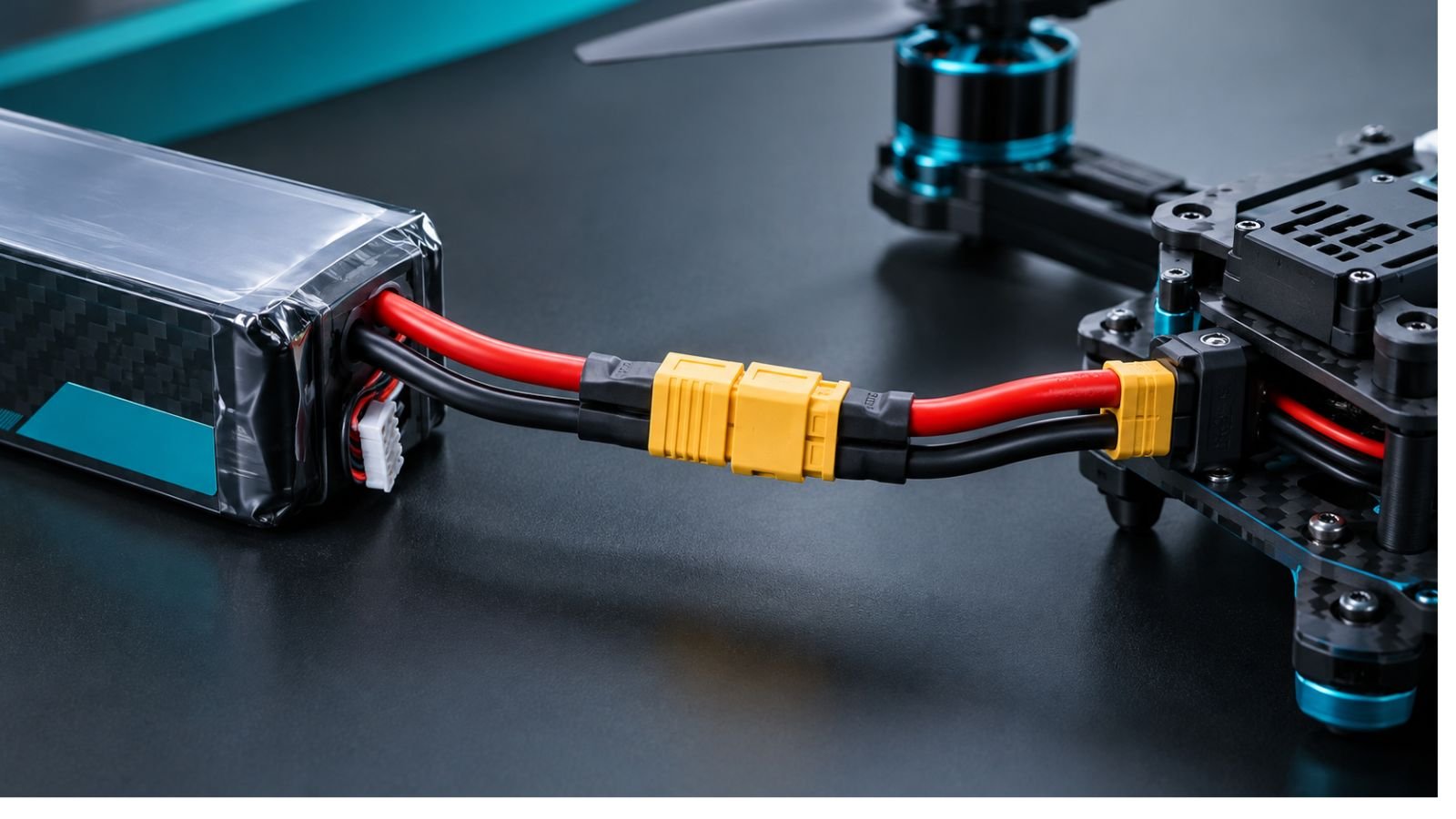
These connectors are particularly common in battery-powered equipment such as RC models, drones, robotics and custom battery packs. Commercial LiPo batteries are available with XT30, XT60 and XT90-family connectors, demonstrating their use across different battery and equipment configurations.
For a connector assembly, the connector itself is only one part of the power path. The cable gauge, solder joint, connector variant and expected operating conditions also affect the overall performance of the connection.
XT30 vs XT60 vs XT90
Although XT30, XT60 and XT90 belong to the same general connector family, they are not simply three connectors with universal 30A, 60A and 90A ratings.
For example, a current Amass-based connector reference lists specific cable variants with different manufacturer ratings: XT30U at 20A maximum with 16 AWG wire, XT60 and XT60H at 35A maximum with 12 AWG wire, and XT90H and XT90S-F at 45A maximum with 10 AWG wire under the stated test condition. These figures are specific to those exact parts and conditions, rather than universal ratings for every connector carrying the XT30, XT60 or XT90 name.
This is why the exact connector specification should always be checked before selecting a component for a power system.
XT30 Connector
XT30 is a compact connector option for applications where connector size and weight are important considerations.
Its smaller form factor makes it suitable for compact battery-powered equipment, including smaller RC models and drones. Battery manufacturers also offer small LiPo packs with XT30 connectors.
When selecting an XT30 connector, consider:
- Required operating current
- Wire gauge
- Battery voltage
- Available installation space
- Connector compatibility
- Operating temperature
A compact connector can be useful when minimizing weight and space is important, but the connector must still be appropriately matched to the complete electrical system.
XT60 Connector
XT60 is a widely used battery connector for applications requiring a larger power connection than compact XT-series connectors.
XT60 connectors are commonly found in RC models, drones, battery packs and other power applications. LiPo batteries are commercially available with XT60 plugs across a range of configurations.
The XT60 family also includes variants such as XT60H. In the referenced Amass-based specifications, the "H" version identifies a cable connector with a back cover around the wire-exit and solder-joint area.
When selecting an XT60 connector, check the exact part number rather than relying only on the XT60 name.
XT90 Connector
XT90 is a larger XT-series connector used in applications where heavier wiring and higher power requirements may be involved.
XT90-family connectors can be found in larger LiPo battery systems and drone applications. For example, commercial high-capacity LiPo batteries are available with XT90-S connectors.
XT90S is particularly relevant when an anti-spark connection is required. The anti-spark function is designed to reduce arcing that can occur when connecting a battery to a system with significant input capacitance.
The exact mating combination is important for anti-spark variants. The referenced Amass specification identifies XT90S-F as the anti-spark female connector designed to mate with the corresponding XT90H male.
XT30, XT60 or XT90: Which One Should You Choose?
There is no single XT connector that is suitable for every application.
Instead, selection should begin with the electrical and mechanical requirements of the system.
1. Check the Current Requirement
Determine the expected continuous current as well as any short-duration peak current.
Do not assume that the number in XT30, XT60 or XT90 automatically represents the connector's usable current rating. Manufacturer specifications can vary between exact variants and test conditions.
2. Consider Wire Gauge
The connector and cable should be selected as a compatible system.
For example, the referenced Amass cable specifications associate XT30U with 16 AWG, XT60 with 12 AWG and XT90H with 10 AWG under their respective catalog conditions.
The actual wire requirement depends on the application's current, cable length, temperature and installation conditions.
3. Check the Physical Size
Available space is another important consideration.
Compact electronics and small drones may benefit from a smaller connector, while larger battery systems may have sufficient space for a larger connector and heavier cable.
4. Consider Anti-Spark Requirements
When a battery is connected to equipment with substantial input capacitance, an electrical spark can occur during connection.
For applications where this is a concern, an appropriate anti-spark connector variant such as XT90S may be considered. The exact connector pairing and manufacturer's specifications should be checked before assembly.
5. Verify the Exact Connector Variant
XT-series names can have different variants and configurations.
For example:
- XT30U — compact cable connector
- XT60 — standard cable connector
- XT60H — cable connector with back cover
- XT90H — larger cable connector with back cover
- XT90S-F — anti-spark female variant
The exact part number should therefore be included in the product specification and purchasing documentation.
Where Are XT-Series LiPo Connectors Used?
XT-series battery connectors are commonly associated with several battery-powered applications.
Drones and UAVs
XT30, XT60 and XT90 connectors are used in different drone power configurations. Connector selection depends on the size of the aircraft, battery configuration, current requirements and wiring.
RC Models
RC cars, aircraft, boats and other models commonly use XT-series battery connectors for convenient battery connection and replacement.
Robotics
Robotic systems can use XT-series connectors for battery and power-distribution connections where the connector specifications match the system requirements.
Battery Packs
XT connectors can be incorporated into battery packs and power assemblies to provide a detachable connection between the battery and equipment.
DIY Electronics
They are also used in suitable custom electronics and battery-powered projects where their electrical and mechanical specifications are appropriate.
Why Connector and Wire Selection Should Be Considered Together
A battery connector does not operate independently from the cable.
The connector, wire, solder joint and electrical load form part of the same power path. A connector may have an appropriate specification while an incorrectly selected wire, poor solder connection or unsuitable installation can still affect the overall system.
This is why connector selection should consider:
- Connector specification
- Wire gauge
- Cable length
- Current profile
- Ambient temperature
- Connection quality
- Mechanical installation
- Required mating connector
XT-Series LiPo Battery Connectors from Infocus Electronics
Infocus Electronics offers XT-Series LiPo Battery Connectors for applications requiring reliable battery and power connections.
The range includes XT30, XT60 and XT90 connector options for different battery and electrical applications. Customers can select the appropriate connector according to their equipment requirements, wiring and intended operating conditions.
For bulk requirements, product enquiries and OEM applications, customers can contact Infocus Electronics for further information about the available XT-Series connector options.
Conclusion
XT30, XT60 and XT90 connectors are widely used in battery-powered applications, but selecting the correct connector requires more than simply matching the connector name with a current number.
The exact connector variant, wire gauge, current requirement, temperature, physical space and application should all be considered before making a selection.
XT30 can be suitable for compact applications, XT60 is widely used across many medium-power battery systems, and XT90-family connectors are commonly used where larger connectors and heavier wiring are required. Anti-spark variants such as XT90S can also be considered for suitable applications where controlled battery connection is required.
For reliable results, always verify the exact manufacturer's specification for the connector being purchased and evaluate it together with the complete wiring and power system.
Frequently Asked Questions
What is the difference between XT30, XT60 and XT90?
They are different connector sizes and variants within the XT family. Their actual current capability depends on the exact connector, wire gauge and manufacturer's specified operating conditions.
Does XT30 mean the connector is rated for 30A?
Not necessarily. The number in the XT-series name should not automatically be interpreted as a universal current rating. Exact manufacturer specifications must be checked.
What is XT90S?
XT90S is an anti-spark variant of the XT90 family. It is designed for applications where reducing connection arcing is important.
What does the H mean in XT60H or XT90H?
For the referenced cable variants, H identifies a version with a back cover around the cable exit and solder-joint area.
Which wire gauge should be used with an XT connector?
Wire gauge should be selected according to the expected current, cable length, temperature and application requirements, while also following the connector manufacturer's specifications.
Where are XT battery connectors commonly used?
They are commonly used in RC models, drones, robotics, LiPo battery packs and other suitable battery-powered equipment.
Can Infocus Electronics supply XT-Series connectors for bulk requirements?
Yes. Contact Infocus Electronics for product availability, bulk requirements and OEM enquiries.